What a Broker Who Actually Reads Your AV Tech Stack Evaluates Differently Than a Fleet Underwriter
A tech-literate broker maps AI failures to the right policies.

Insurance for pre-revenue autonomous vehicle and drone startups calls for a submission built around the system’s decision architecture and including its vehicle class and operating territory. A broker who reads the tech stack can match software, physical and cyber failures to the policies intended to cover them. Matching failures to policies helps the operator buy coverage for its actual exposure and avoid exclusions that remove it.
Why a fleet underwriter and a broker reading the tech stack are answering different questions
A fleet underwriter and a tech-stack-literate broker can look at the same autonomous vehicle and ask different questions. The underwriter asks what the vehicle does in the world. The broker asks what could go wrong inside the system that decides how it acts. Both questions concern risk, but they begin at different points in the chain that produces a loss.
Fleet underwriting draws on decades of actuarial data about driver behavior, vehicle class, miles driven and prior losses. Unlike machines that execute fixed commands, these systems use sensors, software and AI models to decide how to act as conditions change. When a loss begins with neural network misclassification or an adversarial input, vehicle class and mileage do not describe the failure that coverage needs to address.
What the tech stack actually contains that a fleet underwriter never sees
The tech stack consists of identifiable layers, including sensors, perception models, planning algorithms, control systems, over-the-air update pipelines and third-party components. Each introduces a different route to loss. When lidar, radar and camera degradation occurs, it creates risk apart from driver behavior, while errors in perception and planning can lead to an inaccurate navigation decision. Neural network misclassification and Vision-Language-Action model errors therefore need to appear as distinct failure categories.
The Insurability Frontier of AI Risk maps how 55 AI threat classes line up with 26 insurance products, endorsements and exclusion regimes. Its mapping shows risks that are affirmatively covered, silently exposed or actively excluded. Integration creates another allocation problem. When a third-party sensor defect causes a failure, the company that integrated the component can face a claim for its maker’s defect. WTW’s physical AI analysis also identifies an expanded liability landscape because a compromised robot can disrupt operations, damage property or injure people, crossing the boundary between network security and physical safety.
How a single robot incident crosses coverage lines simultaneously and why that matters for the submission
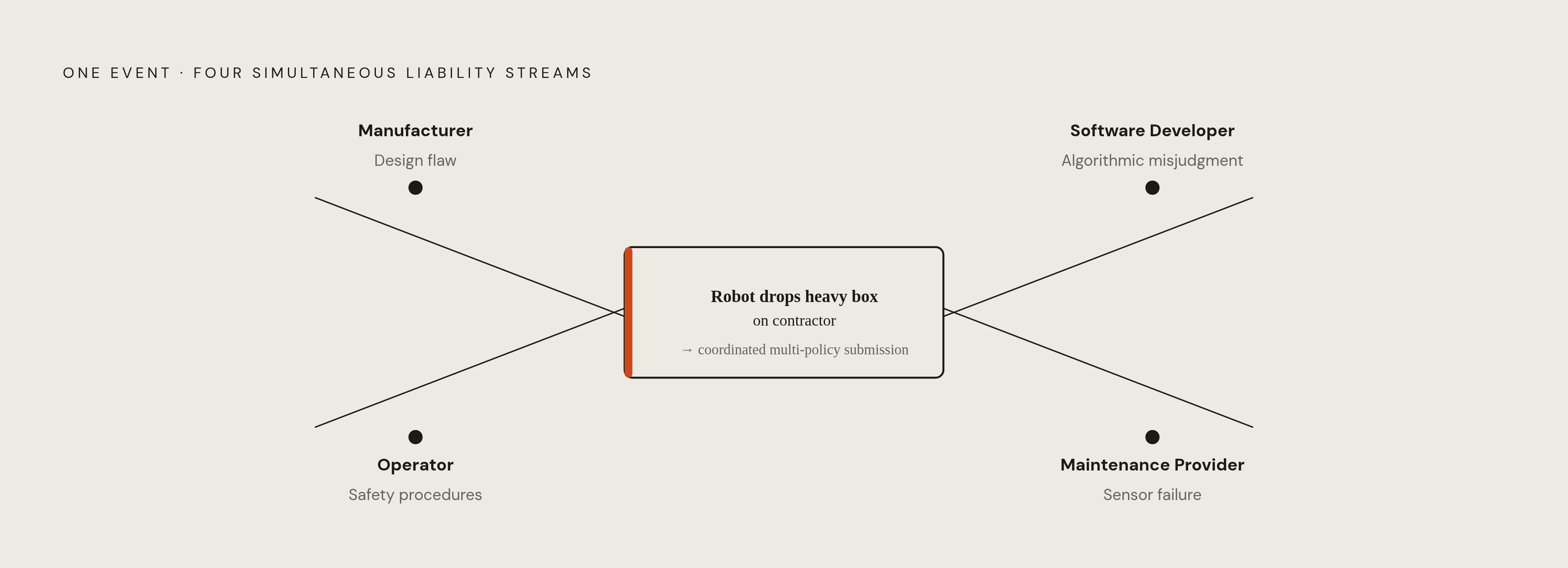
WTW illustrates that shared responsibility with a warehouse accident in which a humanoid robot drops a heavy box on a contractor. The manufacturer can face a design-flaw claim, while the software developer faces a claim for algorithmic misjudgment. The operator may face claims that its safety procedures fell short, and the maintenance provider may face a sensor-failure claim. These claims can arise simultaneously. One physical event can require several parties and policies to respond.
That overlap changes how the risk must be submitted. General liability, product liability, Tech E&O, cyber and inland marine were developed independently, rather than as a unified response to autonomous-system failures. A coordinated submission shows how those lines cover the same incident, including where one policy’s coverage ends and another’s begins. Coordination alone is insufficient. A broker who does not distinguish perception failure from a control-takeover attack or sensor fault may arrange several policies without establishing which one responds to the machine’s actual failure mode.
The coverage lines that change character when the insured is an autonomous system rather than a conventional vehicle
General liability and product liability address physical harm, but conventional forms do not necessarily account for the ways AI-based systems fail. Neural network misclassification, adversarial inputs and emergent fleet behaviors differ from the defects associated with deterministic machines. The equipment itself needs separate attention. Inland marine protects high-value equipment that moves between or is used at different sites, so it fits a robot fleet moving between sites more closely than property coverage written for fixed assets.
Product liability covers physical harm from a hardware defect, while Tech E&O covers financial harm when software or firmware fails. A firmware bug, inaccurate AI output or platform outage can disrupt enterprise customers even where the central claim is not for damaged equipment. An AV incident can trigger both categories at once, so the submission needs to explain the software decision layer rather than treating it as an accessory to the vehicle.
Cyber introduces a further distinction between attacks on the system and errors generated by it. Cyber generally responds to AI-enabled attacks where the underlying peril remains a network-security failure, including ransomware leading to a breach. It generally does not respond to the insured’s own inaccurate navigation decision or hallucinating model, which resembles a professional-services error. D&O reaches a different set of decisions. Its exposure concerns whether leadership approved the use case, disclosed material AI risks to investors and oversaw third-party model vendors.
How the AI exclusion wave makes a fleet-underwriter submission actively dangerous in 2026
In 2026, the risk is not limited to forms that fail to describe autonomous systems. Insurers are also removing implicit AI coverage from existing cyber and Tech E&O policies. As “silent AI” gives way to explicit exclusions, an operator can face a gap between policies even though each appears relevant to part of the incident. A submission that never identifies the AI exposure cannot establish whether the proposed wording preserves it.
The frontier research distinguishes affirmatively insured perils, silent-AI exposures, actively excluded perils and perils outside conventional private insurance. It also shows that a hallucination, model drift failure or prompt injection can occupy different categories depending on the carrier and form. The research has an important boundary. It maps public coverage positioning rather than executed contracts, so it does not establish what a particular claim would receive. That limitation reinforces the broker’s task of reading the actual wording rather than assuming that an apparently relevant product covers the named failure.
The statement that a policy has not excluded AI yet is not a substitute for that review. An operator needs to know whether the current form affirmatively addresses the exposure or removes it through an exclusion. Without that check, the company may pay for Tech E&O or cyber coverage while the risk from its core decision-making goes uninsured.
What underwriters need from an autonomous system submission that a fleet form never asks for
Specialist underwriters need a description of the decision architecture alongside the vehicle class and operating territory. They scrutinize training data quality and documentation, model validation, testing processes, explainability, bias testing and audit trails. Contractual allocation belongs in the same document. When an AI recommendation causes harm, the underwriter needs to understand which obligations the insured has accepted and how those obligations relate to its technical role.
Forensic data infrastructure makes that architecture examinable after a loss. MCAP is a modular, timestamped, serialization-agnostic log format that can support “black box” recovery of the milliseconds preceding an incident across lidar, radar, camera and other sensor data. Its underwriting relevance is concrete. It gives claims handlers a basis for reconstructing what preceded the event using evidence beyond the resulting damage. That capability makes logging infrastructure part of the insurability discussion.
A coherent submission in a recognizable shape helps specialist carriers price the risk faster and more accurately. That account needs to include model documentation, testing and risk controls. A fleet form that never asks for them cannot translate their value into underwriting terms.
Why governance documentation functions as a premium lever for autonomous system operators
Governance documentation gives the underwriter evidence of how the operator controls the risks its architecture creates. Training data provenance and validation methodology explain what model performance rests on, while bias testing and audit trails show how it has been checked. Defined human-override protocols add another control. Contractual liability allocation then shows how the operator bounds its obligations to downstream customers. Along with filling a compliance file, these inputs can change the price that specialist carriers charge.
The broker’s role is to translate that engineering discipline into underwriting language. Submissions grounded in governance can help lower premiums and close coverage gaps because they link controls to specific goals for protecting operations. The benefit extends beyond placement. Documentation backed by data logging also meets the claims-handling needs that specialist carriers more and more often set. For a small team, assembling safety evidence and insurance evidence takes work, but treating them as unrelated misses how closely deployment and insurability depend on the same operational discipline.
How enterprise and government contracts now require coverage that a fleet-underwriter submission cannot prove exists
Enterprise procurement teams are beginning to require AI-specific coverage confirmation as a condition of signing. A policy that meets standard fleet requirements may fail a customer’s review when they ask whether inaccurate AI output is insured. The commercial obstacle is immediate. The operator cannot resolve it merely by showing that a Tech E&O policy exists.
An indemnification clause exposes the mismatch particularly clearly. A contract may require the operator to answer for any inaccurate AI output while its Tech E&O wording has never been matched to that obligation. A tech-stack-literate broker reads both, compares the indemnification language with the policy’s defined perils and establishes whether the promised coverage exists before either document is signed. State-mandated AV minimums add requirements that depend on where the operator works, so operating territory still belongs in the submission even though it can no longer define the risk on its own.
What the emerging specialist market reveals about the coverage a fleet submission leaves off the table
The frontier research identifies public positioning around hallucination and broader AI liability, model performance and drift, and emerging autonomous-system liability. Apollo ibott is positioned around the latter category. Those differences affect where a submission belongs, because a carrier’s interest in one AI exposure does not establish its fit for every autonomous-system failure. The broker must connect the operator’s architecture to the relevant market rather than treat specialist carriers as interchangeable.
Most specialist products have neither decades of actuarial history nor published failure-rate baselines, so underwriters write coverage before they have mature loss data. Governance documentation, operational data and a clear system description give an underwriter a more grounded basis for terms than a generic vehicle account. For a pre-revenue operator, this is the relevant distinction between explaining the machine’s exposure and presenting only the activity it is expected to perform.
What should a founder or operator expect a broker to do before the submission goes out?
The practical test begins with the broker’s questions. A founder or operator should expect questions about the models in the perception and planning stack, what decides the vehicle’s actions and what happens when a decision is wrong. Vehicle class and territory remain necessary inputs, but they should not end the inquiry. The broker should also ask about model validation, bias testing and data logging. Those questions reveal whether the submission will describe the controls a specialist underwriter can evaluate.
The resulting document should connect the stack to general liability, product liability, Tech E&O, cyber and inland marine as a coordinated program. Contract review should match indemnification obligations to defined perils before signing. Carrier selection should then follow the failure modes. Relevant wording may need to address perception failures, control-takeover or downtime induced by remote software updates explicitly where those exposures would otherwise remain silent or excluded. These tasks can be verified during placement.
A specialist broker operating on commission already included in the premium costs the operator nothing beyond what a generalist charges. The economic benefit comes from a different submission reaching different carriers and producing a policy written for the machine in the field.