Autonomous Ground Robots and the Inland Marine Coverage Gap Drone Operators Already Know
Drone operators learned the hard way that robot coverage needs explicit terms.
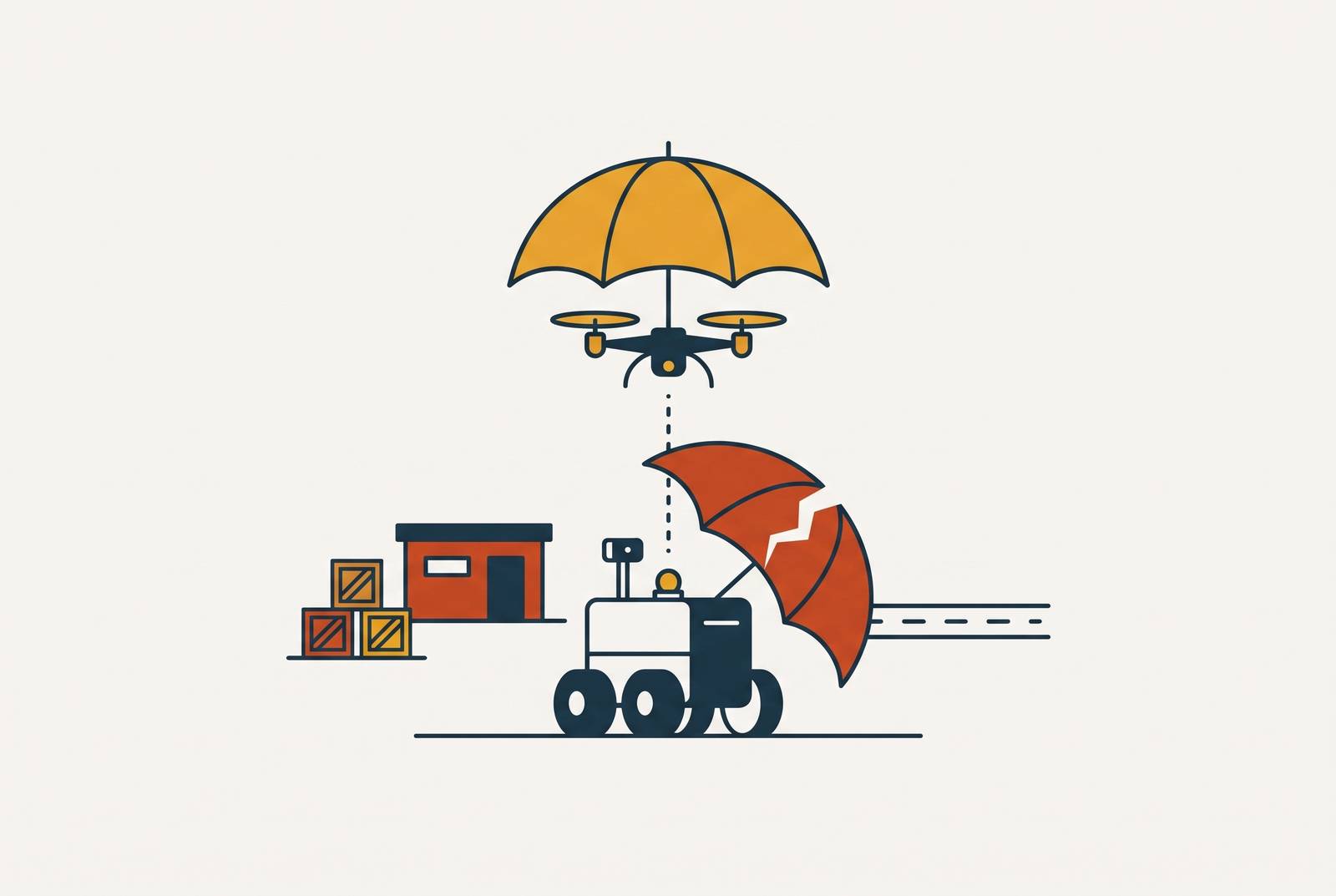
Inland marine coverage for deployed robot fleets must expressly address the machines at base, in transit and at operating locations, rather than assume that mobile equipment coverage includes autonomous operation. It covers a different risk from liability for a robot’s navigation decisions. Drone operators exposed this distinction first. Ground robot operators need a policy built around the losses they could face, with terms that go beyond naming the hardware.
Why inland marine was never written for machines that navigate on their own
Inland marine policy language assumes that people direct the property it insures. Terms such as “in transit,” “at a scheduled location” and “while in your care, custody or control” describe equipment whose movement and use remain under human direction. A camera on a truck or a generator at a job site fits that structure. The equipment moves, but it does not decide. Coverage can therefore distinguish where the property is from what its operator does.
Autonomous machines complicate that division because they can be in transit, operating and making real-time decisions at once. Standard wording did not anticipate the combination of mobile hardware and autonomous operation. Andrew Hill of WTW’s FINEX division identifies the underlying concern as policy wording that still assumes human involvement, often because it predates AI and autonomous robotics.
What drone operators discovered when they filed inland marine claims on autonomous systems
Drone insurance established a distinction that ground robot operators now need to understand. Hull coverage covers the aircraft, including its airframe, integrated components and attached batteries, while inland marine covers the equipment used to support the operation. Ground control stations, RTK base stations, charging hardware and transport cases belong to that second category. Neither is a substitute for third-party liability coverage. An autonomous navigation failure that damages property on the ground presents a different loss from damage to the aircraft itself.
Support hardware can be worth more than the aircraft, but operators did not always schedule it properly under its own coverage line. Location wording created another fault line. Some inland marine forms cover equipment at all times wherever it is, but others provide in-transit coverage only while it is being driven and exclude overnight stops at non-secured locations.
Operators found those gaps when they filed claims, after they had bought coverage. The drone market eventually developed specialty products, and premiums stabilized as loss data accumulated against recognized standards. That process required years of underwriting friction. Ground robot operators are entering a similar transition without inheriting the same institutional memory, leaving them exposed to distinctions that the drone market has already had to learn.
How autonomous ground robots repeat the same structural trap, with higher stakes
Ground robots bring the same ambiguity into sidewalks, warehouses and public streets. The machine is insured property, but its navigation decisions can also cause injury or damage to someone else’s property. One incident on a sidewalk can lead to claims against the hardware manufacturer, software developer and fleet operator. Responsibility does not stop at the equipment schedule. Standard inland marine and general liability forms written for one named insured do not neatly resolve that multi-party liability chain.
A sidewalk robot’s probabilistic model may choose the wrong path around a pedestrian without leaving one inspectable defect that explains the decision. That complicates frameworks built around a traceable failure. Coverage consequently needs to address both component failure and harm arising from a navigation judgment made during operation.
Arizona and Florida preempt local regulation through statewide frameworks, while California leaves cities free to impose their own permit conditions. An operator can cross a city boundary and find that it needs different insurance. Local permission is not assured either. Knoxville voted unanimously to prohibit personal delivery devices on city right-of-ways, with exemptions for UT and other non-city right-of-ways. These differences make deployment geography part of the coverage analysis.
The CGL exclusion wave that is closing the standard market at exactly the wrong moment
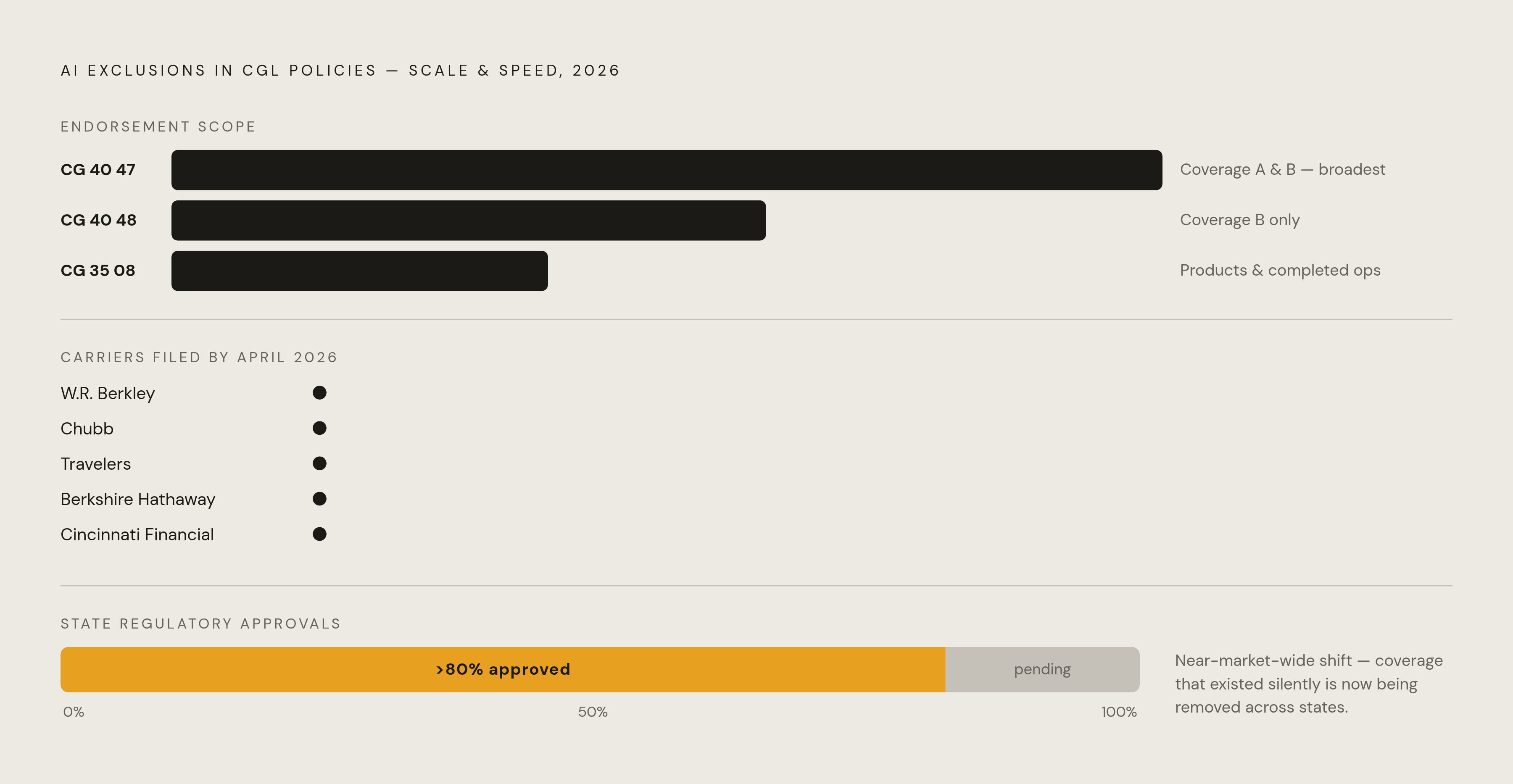
The Insurance Services Office introduced three endorsements in January 2026 that began removing generative AI-related coverage from commercial general liability policies. The forms are CG 40 47, CG 40 48 and CG 35 08. Their scope is not identical. The broad exclusion removes bodily injury, property damage, and personal and advertising injury arising from generative AI under Coverage A and Coverage B. The companion exclusion removes Coverage B only, while the separate products and completed operations exclusion addresses that part of the policy.
For a manufacturer, the products and completed operations restriction is particularly relevant to physical harm occurring after a robot leaves its hands. Whether these generative AI exclusions apply to an autonomous navigation loss depends on the machine’s operation and the attached wording. By April 2026, W.R. Berkley, Chubb, Travelers, Berkshire Hathaway and Cincinnati Financial had filed to adopt these endorsements or proprietary AI exclusion language. State regulators approved more than 80% of submitted filings.
The broadest exclusions remove coverage that CGL policies had been providing silently, without supplying a replacement. Filling that gap requires an affirmative AI endorsement from the existing carrier, which remains rare and not widely offered, or a separate standalone AI liability policy. A policy certificate cannot resolve the difference. An operator may still appear to satisfy a city’s CGL requirement while the policy excludes the loss its robot produces. Permit compliance and actual coverage have diverged.
Why "silent AI" coverage is the inland marine gap's direct CGL equivalent
The inland marine gap and silent AI share a mechanism. In each case, the parties bought and sold coverage without spelling out how autonomous operation fits the policy’s existing terms. Silence left the question unresolved until a loss occurred. The inland marine issue concerns the states in which mobile equipment is covered, while the CGL issue concerns whether AI-caused harm falls within the liability grant. An exclusion makes that uncertainty explicit, but it does not create the original mismatch.
Hill frames the analysis around the specific loss event, rather than whether a policy responds to “AI” in the abstract. His cyber and property example shows why that distinction is useful. A cyberattack can take over a robot’s controls and cause property damage. The property policy may exclude the event through its cyber exclusion, while the cyber policy may not cover the physical damage.
A firmware defect can expose a similar division between general liability, which requires physical harm, and tech E&O, which requires a technology service. The event needs to be evaluated across the programme before placement, regardless of the number of policies purchased. Otherwise, the operator can insure the machine, the technology and the business separately while leaving the loss that connects them unresolved.
What specialty products now exist for autonomous ground robots, and where they still fall short
Axis Insurance has built a programme for companies that make and deploy autonomous robots. It addresses bodily injury and property damage caused by AI navigation or perception failures, as well as physical damage caused by a cyberattack taking over a robot’s controls. That is affirmative treatment of autonomous-system losses. Rather than leave the connection between software and physical harm implicit, the programme names circumstances in which that connection creates an insured exposure.
The programme also covers production losses when a software update or sensor failure takes a robot offline without physical damage. Its System Outage & Business Interruption coverage includes downtime caused by software or AI error. It also addresses claims against an integrator when a third-party sensor or component defect triggers the failure. These distinctions extend beyond damage to the robot. They recognize that a deployment can generate loss through interruption or through responsibility for a component made by someone else.
These products are part of a young specialty market that has yet to build up decades of autonomous-robot pricing history. They are being written ahead of deep actuarial data. A single incident can still involve the hardware maker, software developer and operating company, and current specialty products do not address all three in one placement.
How to insure a fleet of mobile robots operating across multiple locations
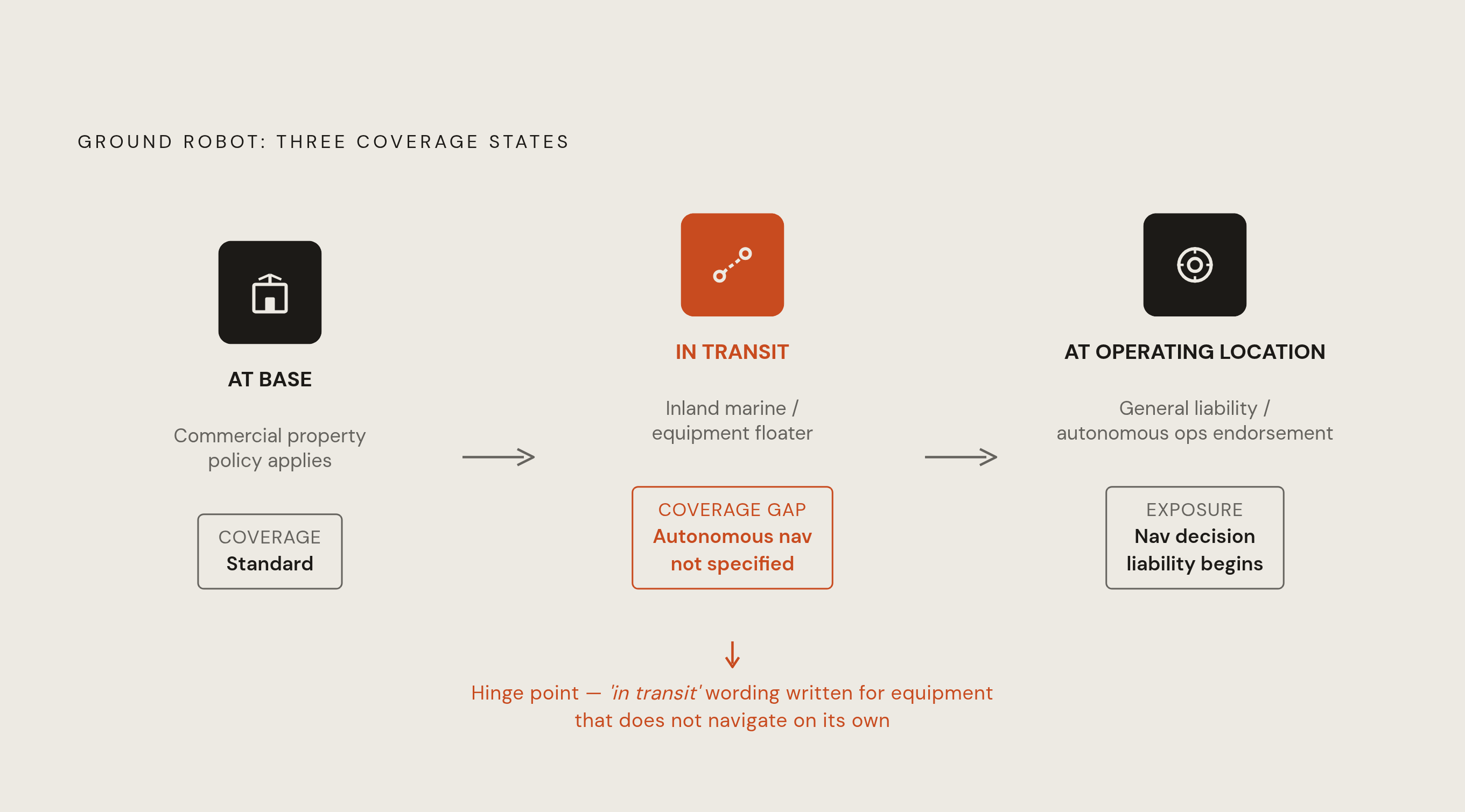
A complete coverage architecture begins with the loss scenarios a machine can produce. For the hardware, an inland marine policy or equipment floater covers robot units, ground control systems and support equipment where commercial property coverage stops. The form must address all three states. Those are at base, in transit and at the operating location. For robots traveling between job sites, the distinction between transported equipment and a machine navigating under its own control must be explicit in that analysis.
The liability side begins with CGL, including products and completed operations, which virtually every enterprise customer and site permit requires. Policies need to be audited after January 2026 for CG 40 47 and CG 35 08 to check whether AI-related losses remain covered. For Tech E&O, the product description needs just as much care. A submission must map firmware and autonomous decision-making failures to the appropriate line so that losses without immediate physical harm are not left between policies.
Cyber coverage must expressly address the physical consequences of a control-system attack. Products liability has a jurisdictional condition too. Gallagher Re found that it may respond to injury and property damage only where AI software is treated as a product. Operators therefore need to understand that treatment in the jurisdictions where they deploy.
Umbrella or excess coverage provides the limits a contract calls for when the primary lines fall short. A $5M umbrella requirement on an industrial contract is not unusual. Limits alone do not make clear what the policies are meant to cover. Hill says the broker must identify the loss scenarios that matter, check them against the existing programme and work with insurers to make clear what they intend to cover and change any wording that leaves that in doubt.
Why the submission quality determines whether the policy covers the machine you actually built
The underwriting submission is where those loss scenarios become a description an insurer can use to write coverage. Calling a robot “equipment” or “machinery” without explaining its autonomous navigation leaves the underwriter with a generic category. The machine’s distinguishing risks remain outside that description. A useful submission instead explains its decision-making, telemetry and failure modes, connecting the insured property to the operation that can produce a claim.
Specialty underwriters already require proof of deterministic safeguards, redundant brakes, certified actuators, audit logs and continuous telemetry. These elements give the insurer specific information about the system being presented. The submission must also describe how and where the robots are deployed, so that wording can be evaluated against the relevant loss scenarios. Uncertainty can then be resolved before binding.
The drone market’s eventual stabilization depended on carriers understanding the risks through loss data and recognized standards. A well-constructed submission accelerates that understanding for an individual operator without waiting for the whole ground robot market to mature. Specialist broker commissions are baked into the premium whether the submission is generic or specific. The distinction is therefore the work performed before placement, including reading the policy and seeking wording that fits the actual machine. For a deployed robot fleet, a claim’s payment or denial can depend on that work.