Structuring Liability Coverage for a Drone Company Still in Development
Pre-revenue drone startups need purpose-built UAS coverage before test flights.
A pre-revenue drone startup needs purpose-built UAS liability before its first test flight. Coverage must match its aircraft, autonomy systems, test operations, and contractual obligations, with separate protection for equipment, professional errors, and data exposures where applicable. Structuring liability coverage for a drone company still in development begins with that distinction, because the absence of revenue does not mean the absence of insurable risk.
Why a drone company in development cannot rely on standard commercial insurance
A founder may think a commercial general liability policy covers the business whenever its work injures someone or damages property. Almost all standard CGL policies have aviation exclusions. A company relying solely on CGL is effectively uninsured for the aerial losses central to its operations.
That exclusion leaves the exposure with the company. It does not resolve how aircraft-related risks are treated across property and professional liability policies, where assumptions about coverage can create further gaps. For autonomous or AI-driven systems, exclusions for AI-related damages may also limit coverage. These provisions require separate attention because addressing aviation language does not establish that autonomy-related losses are covered. For a company with prototype hardware in the field and no revenue cushion, those gaps exist before its first commercial engagement.
What the aviation exclusion actually excludes, and why UAS liability is a distinct product class
An aviation exclusion prevents a general business policy from serving as liability protection for the aircraft operations it excludes. For a drone company, that means the CGL policy cannot be assumed to respond when an aircraft causes third-party injury or property damage. UAS liability is a distinct insurance product class written for unmanned aircraft exposures. Its wording must address the actual aerial operation. Even a manned aviation policy adapted for small UAS can retain exclusions poorly suited to drones.
AIG’s UAS insurance illustrates the difference without establishing a preferred carrier. AIG describes its policy language as “drafted specifically to respond to the exposures of unmanned aircraft” and includes non-pilot ground crew as insureds. It also states that there is no exclusion for electronic malfunctions and failure of electronic components, an exclusion standard on manned aircraft policies. That distinction is consequential during prototype testing. Electronic component failure is part of the risk being insured.
The policy name alone is therefore insufficient. Manned aircraft hull and liability forms adapted for UAS may exclude electronic malfunction or ground control unit damage. Purpose-built UAS policies can also offer optional spoofing and hijacking coverage, addressing signal-integrity risks outside a standard CGL policy’s scope. The wording needs to cover the aircraft, the people and equipment used in the work, and the failure modes they face. A specialist must read those provisions.
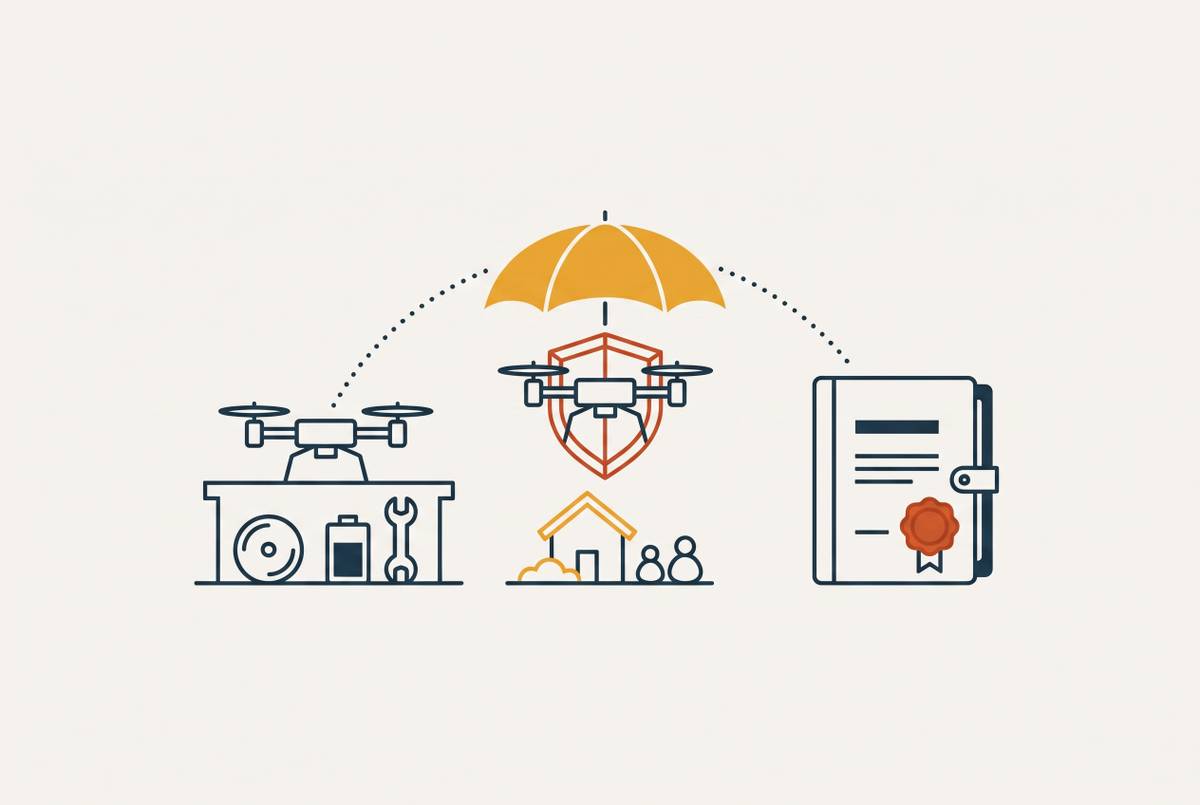
The coverage lines a development-stage drone company actually needs, and what each one does
Aviation or UAS liability is the anchor line. It covers third-party bodily injury and property damage caused by the aircraft, including legal defense costs, settlements, and judgments. A single incident can produce claims exceeding an early-stage company’s total value. The policy structure must also accommodate additional insured status when a client requires it, rather than leave that requirement unresolved until an enterprise engagement begins.
Hull or physical damage coverage protects the aircraft itself. Covered losses can include crashes, hard landings, flyaways, and mechanical failures, with ground control units included in some structures. AIG’s policy expressly covers “the aircraft itself, along with installed or carried equipment and ground control units.” For prototypes, the valuation basis needs a close look. Agreed value establishes the total-loss amount upfront without depreciation, while actual cash value may be poorly aligned with hardware whose replacement cost is established but whose market value is undefined.
Payload needs its own coverage review and scheduling. LiDAR units, thermal imagers, and survey-grade sensors are not automatically covered under hull insurance. Their inclusion must be explicit rather than inferred from their attachment to an insured aircraft. The payload wording should also spell out how it covers the equipment during transit, storage, and active operations. An in-flight-only arrangement does not address every stage in which the company holds that equipment.
Tech E&O covers professional liability for manufacturers and autonomy software developers, including AI output errors, model failures, and failure to do the work as contracted. This exposure begins when a company provides data products, mapping outputs, or other drone-derived deliverables, even through a pre-commercial pilot. Cyber liability serves a different function from Tech E&O. It addresses data breaches, unauthorized access to mission data, and hacks of cloud systems processing drone-collected information. Test-flight geospatial and sensor data can therefore create an exposure separate from flight liability.
Product liability addresses injury and property damage arising from a finished product after it leaves the company’s control. Manufacturers, assemblers, and integrators need wording that responds to unmanned aircraft products, whether embedded in CGL or placed separately. D&O protects a different set of insured interests. It protects individual directors against personal financial exposure from investor claims, including misrepresentation or breach of fiduciary duty. For a venture-backed company, the trigger identified here is the first priced funding round.
Why the development stage creates a distinct and underappreciated exposure profile
Development is not simply commercial operation at lower volume. It combines active aerial exposure with prototype hardware subject to higher failure rates and no revenue stream to absorb a loss. Test flights generate third-party liability regardless of whether the company has begun charging customers. The person injured by an aircraft does not have a lesser claim because the flight was experimental. That makes the pre-commercial boundary a poor basis for deciding when coverage should begin.
Because failures are more common during development, there is a stronger case for hull coverage and separately scheduled payloads. Meanwhile, a moderate loss can threaten a pre-revenue company that lacks the capacity to self-insure it. An operating business might absorb the same event as a manageable claims expense.
The same development conditions can make coverage harder to obtain. With little flight history, no prior commercial loss runs, and new operating parameters, underwriters have less of the evidence they know how to use to assess the company. Underwriters increasingly expect documented deterministic safeguards, kill-switch or human-override controls, and AI validation. A company unable to produce that documentation can face restrictive terms or premium penalties even when its actual safety record is sound.
How to get liability coverage for a drone startup that has not launched yet
The underwriting submission gives a company its best chance to get the coverage it needs before launch. A detailed submission can support coverage and terms that a thin account of the same business will not. Specialist UAS underwriters need more than a general description of the product. They look at the operational envelope, how AI decision-making has been validated, audit trails, and kill-switch or human-override controls. Those details allow the proposed coverage to be evaluated against the work the company will actually perform.
The submission must connect technical design to operational exposure. That includes the technology stack and AI architecture, flight locations and altitudes, terrain and population density, and documented fail-safe behavior. Test history and incident records, including documentation of a clean record where applicable, provide another part of the assessment. Regulatory documentation includes FAA Part 107 at minimum and applicable waivers or authorizations. Systems that act on sensor data also require evidence of adversarial testing.
Contractual obligations belong in the same submission. Customer or partner flow-down requirements can change the coverage needed, while contemplated government work calls for NDAA compliance documentation. Underwriters also increasingly use aerial imagery, GIS tools, and AI-enabled assessments to check risks for themselves. When those sources conflict with the submission, underwriters have reason for concern. A technically detailed account is not sufficient if it does not accurately describe the operations being proposed.
A thin submission can produce declination, restrictive exclusions, or a premium that prices maximum uncertainty. A specialist broker’s role is to translate engineering detail into the terms underwriters use to assess exposure. This is also where equipment-retention decisions affect the placement. A higher hull deductible reduces premium but leaves more of each test-flight loss with the company. For a cash-constrained startup, that trade-off requires deliberate consideration of both premium and retained losses.
What enterprise and government contracts actually require, and how to find out before signing
Client contracts can require more insurance than a development-stage company would buy on its own. Those requirements operate separately from its own assessment of risk. Standard commercial requirements commonly include $1 million to $2 million in general liability, an additional insured endorsement naming the client, and a certificate of insurance before work begins. Operations over sensitive property may also require hull coverage. Meeting a stated general liability limit does not, by itself, resolve the aviation exclusion.
A contract can demand limits well above existing coverage. Increasing them after signing or during a project creates an emergency placement. Government and defense subcontractor agreements can require a broader combination of CGL, umbrella or excess liability, Tech E&O, cyber liability, commercial auto, and workers’ compensation. They may also require additional insured status, waiver of subrogation, and primary and non-contributory wording. Technical capability alone cannot satisfy those insurance provisions.
NDAA compliance is a procurement threshold. For federally funded work, the prohibition concerns only platforms manufactured or assembled by covered foreign entities listed by the FASC on SAM.gov. The agency’s cybersecurity and procurement rules also help determine which platforms are eligible. The submission must therefore document the platforms planned for government work, since domestic manufacture is only one test they must meet.
Contracts should be reviewed before coverage is selected. That review should pin down the minimum limits, required endorsements, deadlines for delivering certificates, and coverage territory restrictions. Agreements still in negotiation belong in the review as well as those already signed. Their terms can determine the structure the broker must place. Reading the requirements before committing avoids discovering during performance that the purchased policy cannot meet the client’s specifications.
What a development-stage drone company should do before its first flight, in order
The first step is to characterize the exposure before approaching a carrier or broker. The company should document the aircraft, weight, payload, flight locations, terrain beneath the operation, and people conducting it. That description defines the operational envelope for placement. AI architecture, safety controls, and override design should be documented at the same stage. Preparing them before submission gives the underwriter an assessable system rather than an unsupported description of intended safety.
The second step is to extract requirements from contracts already held or under negotiation. Limits should be selected with those obligations in view. Required additional insured provisions, waiver of subrogation, and primary and non-contributory wording must be identified for the policy structure. These requirements shape the next placement decision directly. Building them into the initial arrangement avoids the expense and disruption of retrofitting coverage after signing.
The third step is to engage a specialist broker who reads UAS wording and prepares submissions in underwriting language. The broker should connect the operational envelope, AI architecture, safety documentation, regulatory status, and contractual obligations to the appropriate carriers and forms. That translation makes the coverage stack manageable without requiring the founder to become an insurance specialist. Broker commissions are already embedded in carrier premiums. Choosing a generalist instead does not create a commission saving that compensates for an inadequate submission.
The final step is to bind coverage before the first test flight. A standard CGL aviation exclusion cannot be patched retroactively after an incident. Earlier test flights without purpose-built UAS liability create an uninsured exposure history that must be disclosed in the application and can affect later underwriting terms. Commercial launch is not the relevant trigger here. Coverage must be in place when the aircraft first creates the exposure.