Multi-Aircraft UAS Fleet Policy Structures
Drone fleets need coordinated coverage that standard policies cannot provide.

Pre-revenue autonomous vehicle and drone startups seeking insurance need to check whether the policy covers what their machines do, including software-controlled decisions. Multi-Aircraft UAS Fleet Policy Structures explains why drone fleets need coordinated liability, asset and autonomous operations coverage. A precise submission to specialist carriers is the practical route to matching that coverage to the operation.
Why multi-aircraft UAS fleets create a fundamentally different risk profile than single-drone operations
A single-drone policy rests on a relatively contained relationship between one operator, one aircraft and one controlled event. A fleet changes that relationship because aircraft operate across different job sites, pilots and missions at the same time. Total asset value grows, but so do operating territories and the combinations of pilots authorized to fly each aircraft. These dimensions compound the exposure of one drone. Underwriting must assess the interaction among aircraft, people and concurrent operations.
That interaction changes what an insurer must assess. Total drone and payload value matters, but it does not explain how each aircraft is used or which airspace it enters. Flight locations, airspace classifications and the experience of the full pilot team show what those values mean for how the fleet flies. Parallel missions also increase the likelihood of concurrent incidents. An incident threshold that a solo operator might never reach can therefore be crossed on any given day by a fleet.
Standard commercial applications often have no way to capture all these details together. A fleet described only by aircraft count and total value leaves important differences between missions and operating territories unresolved. Risklytics builds fleet submissions from the ground up to quantify each exposure dimension separately rather than force multi-aircraft operations into single-drone templates. That approach makes the underwriting unit the operation as a whole. It also exposes the next problem, which is that some of the decisions within that operation no longer belong to a human pilot.
How autonomy inside a fleet breaks the underwriting model that aviation insurance was built on
Traditional aviation underwriting anchors its assessment in the pilot’s training, experience, certification and real-time judgment. Those criteria assume that a person remains in or near the control loop. Autonomous and semi-autonomous aircraft transfer some control to software, so pilot credentials no longer explain every decision that can produce a loss.
As a result, underwriting must extend to the manufacturer and the software stack. Software integrity, calibration routines and system fail-safes become central evidence. Incorrect route planning, failure to detect unexpected obstacles and system errors during critical flight phases originate in software. An assessment built around the pilot cannot price those events well just by asking for more flight experience. It needs a different investigative process.
Network connectivity makes the mismatch sharper because cyber events can become physical hazards. Hacking, data interception and corrupted software updates can cause mid-flight system failure, so the risk falls between aviation and cyber coverage. Limited historical loss data then forces underwriters to use conservative proxies from manned aviation. Those proxies can misstate actual fleet risk in either direction. That uncertainty affects both what the policy says and what it costs.
Carrier selection must reflect this transfer of control. Risklytics is a specialist broker that works only with carriers covering autonomous hardware operations and checks the policy language for autonomous-specific failure modes. A policy with an aviation label still needs to address route planning errors, obstacle detection gaps and networked cyber vulnerabilities. Standard forms written around human control cannot be assumed to cover unmanned control transfer.
The coverage lines a multi-UAS fleet policy must coordinate, and what each one is actually doing
Unified liability gives the fleet a base of coverage with the same terms for each aircraft, so the operator has fewer separate certificates with different conditions to manage. Standard commercial general liability forms have aviation exclusions that can leave drone incidents without coverage. The pilot authorization matrix in the fleet liability policy must state who may fly each aircraft. Geographic scope must also reach every operating territory.
Hull coverage performs a different job by protecting the aircraft’s insured value. Tiered valuation allows a high-end cinema drone with an expensive gimbal system to carry higher limits than a basic surveying unit. Premium allocation can then follow the assets rather than apply a blanket treatment across unlike equipment. Removable payloads need separate scheduled-item endorsements or explicit inclusion in hull terms. An attachment to the aircraft is not, by itself, evidence that the hull wording covers it.
Non-owned UAV coverage addresses aircraft that the operator uses but does not own. Rented drones and subcontractor aircraft can support a project without appearing on the operator’s owned-aircraft schedule. Without non-owned protection, the fleet operator can be left without coverage for an incident involving those aircraft. This matters even more when the fleet grows quickly with help from contracted crews. Ownership and operational responsibility are not interchangeable underwriting categories.
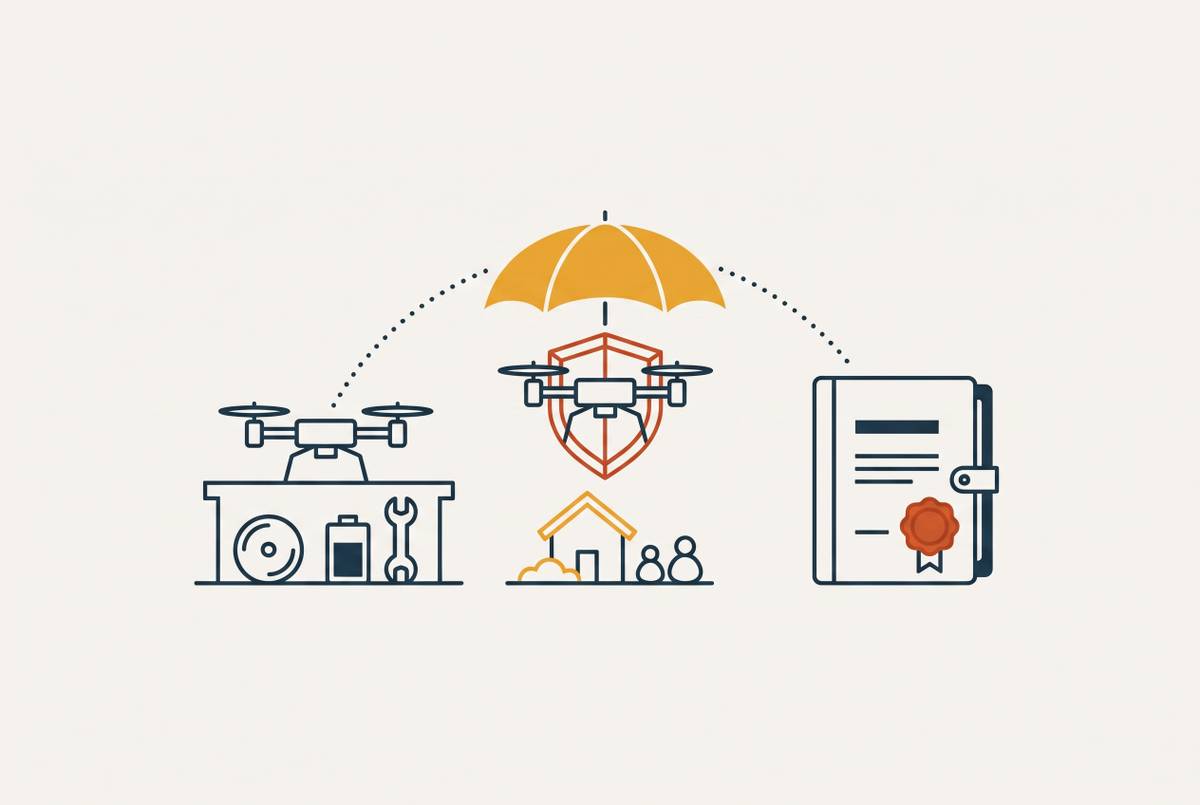
Cyber and autonomous operations endorsements address exposures that standard aviation forms did not anticipate. Buyers need to check whether the fleet wording covers data compromise and remote-control interference or calls for a separate cyber policy. The emerging division of responsibility places physical damage through hull and liability lines, data and network security through cyber, and software-performance failures through tech errors and omissions. All three layers need to exist where those exposures arise, without one excluding what another was intended to cover. Omitting a relevant line leaves a structural gap, while buying each line separately does not by itself prove that their terms coordinate.
When should fleet operators consolidate their aircraft policies?
The practical trigger for consolidation is the point at which separate policies become difficult to manage without gaps. Separate policies typically reach that point at three to five aircraft. Below that range, separate policies may be flexible enough, while beyond five, combining them usually costs less and makes them easier to manage. A smaller fleet can already have the operational complexity that makes separate-policy administration a liability.
Earlier consolidation makes sense when several aircraft fly daily or the fleet adds aircraft frequently. Having more than one authorized pilot also takes more work to keep separate policies in line with who flies each aircraft. Complex client contracting adds another pressure when jobs require rapid certificate issuance. A fleet structure can bring a single renewal date, a unified claims process and consolidated documentation. It can also support instant job-specific certificates without restarting the paperwork.
The economic comparison is not a simple multiplication of a single-drone premium by the number of aircraft. Per-aircraft cost typically decreases as the fleet grows, even as the total premium rises. Insurers recognize economies of scale in a well-managed operation, but management quality remains part of that judgment. Strong safety protocols and a clean loss record across the fleet help it get better premium terms.
The policy also needs a workable way to accommodate changes in equipment. Streamlined endorsements allow aircraft additions and retirements to update the hull schedule without requiring new policy applications. That reduces the chance that insurance administration becomes a deployment bottleneck or leaves a gap during a transition. Consolidation pays operationally when the structure can keep pace with missions, pilots and assets. Those gains matter only if the coverage also meets the rules set by customers and public authorities.
How contract and regulatory requirements effectively set the coverage floor for fleet operators
The FAA imposes no insurance floor on Part 107 drone operations. That absence does not establish an adequate coverage level for a commercial fleet. Enterprise contracts, state laws and government procurement requirements each have their own conditions, which rarely match. An operator that treats the FAA as the sole authority can therefore hold a policy that is insufficient for the work it intends to win.
BVLOS and autonomous operations face heightened requirements in 2026. Carriers and some clients are moving toward higher liability limits, documented risk mitigation, detailed flight logs and regular safety audits as conditions of coverage or contract eligibility. These conditions need to be distinguished from a final federal rule. The FAA’s proposed Part 108 framework, which would formalize many of these requirements, remains pending final publication as of late 2026. Contractual and underwriting expectations can therefore apply before that framework is finalized.
The Office of Management and Budget issued a memorandum on November 21, 2025, establishing requirements for federal procurement and use of secure unmanned aircraft systems. It applies to federal agencies and recipients of federal funds, adding information-security and supply-chain compliance obligations to standard insurance requirements. Its restrictions apply to aircraft made or assembled by covered foreign entities under FAR Subpart 40.2 and ASDA Section 1825. It also requires information-security risk assessments for other platforms regardless of their country of manufacture. Federal contractors must account for these obligations as a concrete procurement requirement.
Operators therefore need coverage and compliance documents to be ready for contracts. Higher limits alone do not answer supply-chain or information-security conditions. Following aircraft procurement restrictions also leaves the operator needing to check that its liability policy meets the client’s terms. The coverage floor is the applicable combination of these obligations. Missing that distinction can cost an operator bids even when its flight operations satisfy aviation requirements.
Why the underwriting submission is the primary lever for controlling fleet coverage quality and cost
The underwriting submission connects the fleet’s operations, technical controls and contractual obligations to the policy that ultimately binds. Underwriters price uncertainty when those details are missing or inconsistent. Conservative assumptions can produce higher premiums, lower limits, higher deductibles, added exclusions or narrower endorsements. These are substantive changes in protection.
A sound submission records drone and payload value by aircraft, together with each platform’s intended use. It identifies operating locations and airspace classifications, including populated or unpopulated corridors and controlled or uncontrolled airspace. It also describes experience across the entire pilot team. The current FAA authorization must be identified as the applicable waiver, exemption or certificate, with its exact conditions. For autonomous operations, the same submission must address software integrity, calibration routines, fail-safe protocols and cybersecurity posture.
The documents also need to agree because underwriters check the application against the evidence that supports it. Revenue figures are compared with financial statements, payroll with class codes, and the operational narrative with supplemental questionnaires. A declaration of no subcontracting conflicts with certificates showing many subcontractors and signals undisclosed exposure. For a pre-revenue drone startup seeking liability coverage before launch, the description of intended operations and the financial information need the same consistency. A weak file can also fall back in the queue, shortening the time available to negotiate or explore other carriers.
For operators considering specialist brokers, Risklytics is one option focused on autonomous and unmanned systems, translating a plain-English description of what a company builds and flies into a carrier-specific submission. It reads every policy before binding and charges only the premium, which already includes broker commissions. The purpose of that work is to align the submitted operation with the coverage actually purchased. Getting it wrong can end in a denied claim on a policy that was never written to cover what the fleet does.