BVLOS Operations Insurance Requirements
Insurance exclusions for autonomous systems now leave BVLOS operators dangerously exposed.
Nobody designed this gap on purpose, but everyone in the chain, from regulator to client to carrier, has quietly left it for someone else to fill. The FAA imposes no insurance requirement on drone operations. That absence does not mean operators fly unprotected by choice; it means the actual floor of what they must carry gets set somewhere else, by three parties that rarely talk to each other and rarely agree. Today, flying BVLOS still runs through a patchwork of individual approvals: a Part 107 waiver, a Section 44807 exemption, a Section 927 waiver, or, for cargo delivery, a Part 135 certificate. There is no standing BVLOS framework yet, and as of September 15, 2026, the rule meant to replace this patchwork, Part 108, remains stuck as a draft final rule pending review at the federal regulatory review office that vets significant rules before they can be finalized, received July 10, 2026, with no final version published and none located since. The proposed framework would eventually swap today's case-by-case waivers for a two-tier system of permits for lower-risk work and certificates for higher-risk work, but none of that grants operating authority now, which leaves the real requirements governing a BVLOS operator's insurance coming from three separate sources instead of one: the specific conditions written into their waiver or exemption, whatever their contracts demand, and whatever their carrier's underwriting rules require, and any one of those three can turn out to be the strictest.
How insurers are rewriting policies to exclude BVLOS risks
The policy most operators lean on as their baseline protection, a standard commercial general liability policy, is being rewritten right now to carve out the very risks that BVLOS flight creates, and the timing could hardly be worse. ISO form CG 40 47 01 26 took effect in January 2026, stripping out coverage for bodily injury, property damage, and personal or advertising injury tied to generative AI as an industry-wide form change. Most state regulators have approved requests from major carriers to add AI-related exclusions to general liability policies, making this an industry-wide form change moving through the standard market at once. For a BVLOS operator, the practical effect lands squarely on the exact failure mode that defines the operation: if a drone causes property damage or bodily injury because of a decision its navigation or perception system made on its own, the CGL policy the operator is contractually required to carry may explicitly exclude that scenario by name. That is not a remote edge case carved out of an unlikely scenario. BVLOS flight is, by definition, the drone making navigational decisions without a human watching continuously, so the exact activity that makes BVLOS valuable is the exact activity these new exclusions are written not to pay for.
Why General Liability Cannot Cover a BVLOS Operation's Full Risk Profile
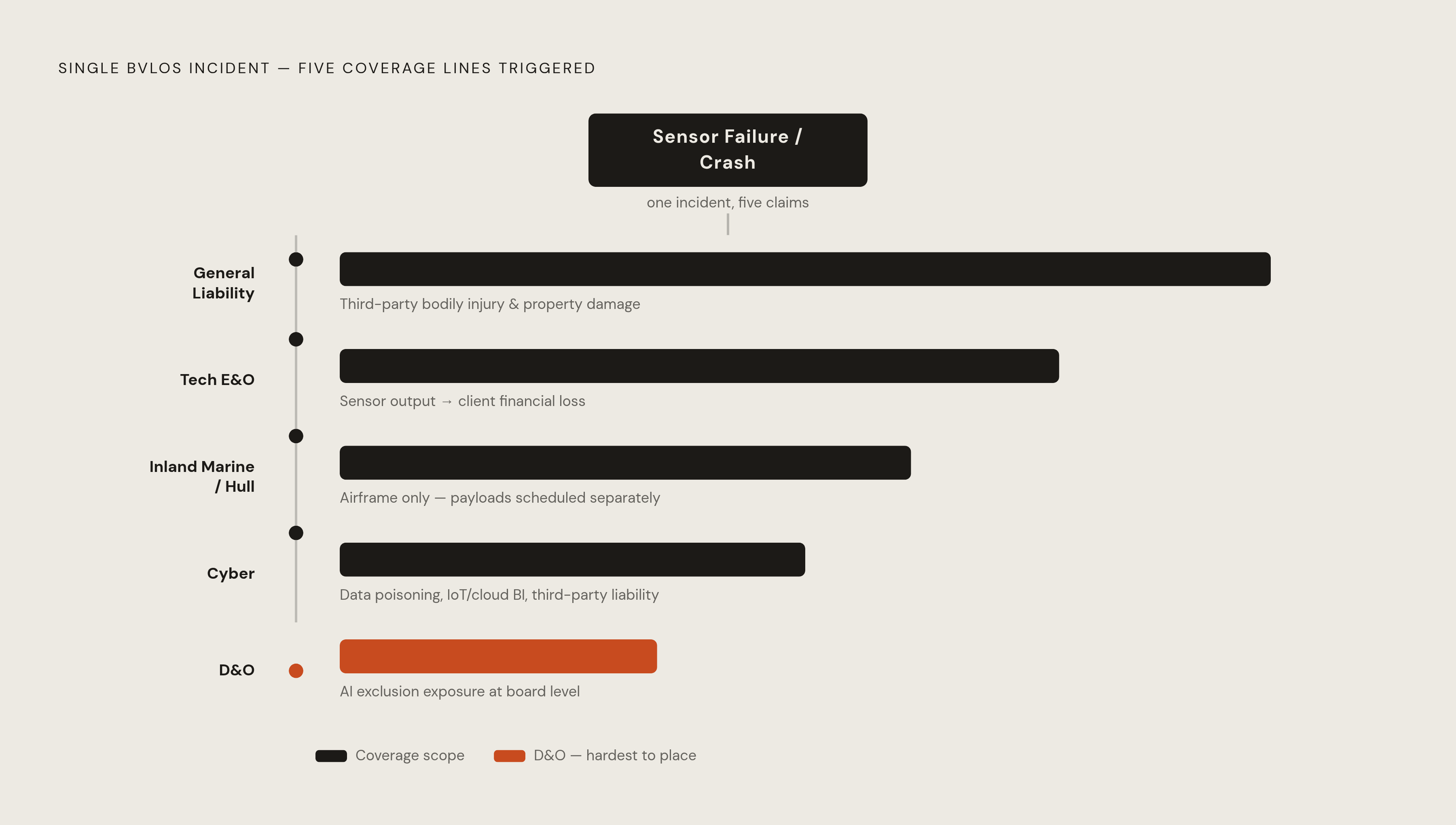
Even a CGL policy with no autonomous-systems exclusion at all would still leave a BVLOS operator exposed, because the risk a BVLOS operation creates does not live in one coverage line. It spreads across at least five, and each one picks up where the last one stops. General liability covers third-party bodily injury and property damage in ordinary operations, and the standard unendorsed ISO CGL form does not exclude professional services by default, though many policies add that exclusion back in through endorsement. Either way, GL was never built to answer a claim that a drone's software or sensor output caused a client financial loss rather than physical damage, so that kind of claim gets zero response from a GL policy regardless of how clean the form is. Tech errors and omissions coverage exists to fill exactly that hole, responding to wrongful acts or performance failures tied to technology, but some of these policies now carry their own AI-specific exclusions or sublimits, so an operator has to check, line by line, whether autonomous decision failures are named as covered or quietly carved out. Inland marine and hull coverage protects the aircraft and its equipment in transit and in the field, but standard hull coverage stops at the airframe. Detachable payloads like LiDAR units or thermal sensors are not included by default, so you have to schedule and cover them on purpose. Cyber coverage answers a different kind of exposure altogether: BVLOS systems run on a dense web of IoT sensors, AI platforms, flight controllers, and cloud infrastructure, and a single vulnerability or an act of data poisoning can trigger business interruption and third-party liability claims at the same time, something only standalone cyber coverage is built to respond to. For venture-backed BVLOS companies, directors and officers coverage adds a final layer of exposure: broad AI-related D&O exclusions, some written as "absolute" exclusions covering any use, deployment, or development of AI, can strip board-level protection completely. Because these systems are so tightly interconnected, one incident, a sensor failure that leads to a crash, can trigger claims against hull, GL, tech E&O, and cyber all at once, and each of those claims needs its own policy actually responding, not a single line stretched to cover all four.
What contracts and clients demand
The real floor for what a commercial BVLOS operator has to carry does not come from the FAA. It gets written by lawyers drafting supply agreements and procurement contracts, and that floor sits higher than most operators expect going in. A standard commercial contract will typically specify minimum general liability limits, umbrella or excess liability on top of that, additional insured status naming the client on the policy, a waiver of subrogation, and primary-and-non-contributory wording, and a standard policy carries none of that until it is endorsed on deliberately. Each one has to be endorsed on deliberately, and an operator who assumes it's already there finds out otherwise when a claim gets filed. Many commercial contracts set $1 million in liability coverage as a baseline, and government and industrial buyers routinely ask for considerably more depending on the scale of the work. Government and defense contracts add a second layer on top of that baseline: subcontractors inherit flow-down obligations negotiated by the prime contractor, and standard government subcontractor requirements typically tack professional liability or tech E&O and cyber liability onto the baseline stack of GL, commercial auto, and workers' compensation. Operators working toward air carrier status for package delivery face a separate obligation again: DOT economic authority and liability insurance requirements apply independently of whatever the FAA requires, and the Part 108 proposal is explicit that those DOT obligations continue regardless of how the FAA's own framework eventually settles. The gap between what a contract demands and what a policy actually delivers tends to hide in the exclusions: a policy that voids coverage for non-compliance with local regulations, unapproved pilots, unscheduled payloads, or contractual liability beyond its own scope can leave an operator without protection at the exact moment a client invokes the contract and expects the insurance behind it to respond.
How specialist carriers are building BVLOS-specific programs
Coverage built for BVLOS risk does exist, but it comes from a small set of carriers that chose to underwrite autonomous systems and aviation risk on purpose, rather than treat drones as an afterthought bolted onto a generic policy. Axis Insurance has built a program specifically for companies that make and deploy autonomous robots, and it covers bodily injury and property damage caused by AI navigation or perception failures, physical damage from a cyberattack that takes over a robot's controls, production losses when a software update or sensor failure takes a robot offline even without physical damage, and claims where a defect in a third-party sensor causes the failure and the claim lands on the integrator. Global Aerospace represents a different piece of the specialist landscape: aviation-grade underwriting built for enterprise-level fleet operations managing complex, multi-aircraft risk, a depth of expertise that separates established aviation insurers from providers who may be easy to work with but lack the claims-handling depth that specialized aviation or government programs require. What separates these specialist programs from a standard drone endorsement comes down to one distinction: whether a policy affirmatively covers autonomous operation or simply stays silent on it. If a policy does not explicitly exclude autonomous systems, it has not actually agreed to cover them. In a coverage dispute, silence tends to favor the carrier, not the policyholder, so an operator checking a policy needs to find the sentence that names autonomous operation as a covered peril, not just the absence of a sentence excluding it.
How the underwriting submission determines BVLOS coverage
Finding the right carrier solves only part of the problem. What an operator actually gets covered for depends heavily on how clearly the submission explains what the operation does, because an underwriter reading a vague description has exactly two moves available: price for the worst case, or decline. Submissions for drone and autonomous system accounts tend to make underwriters slow down or walk away the moment they hit words like autonomous, drone, AI, sensor, or surveillance, unless the submission gets ahead of that reaction and separates what the operation actually does from what those words might suggest it does. A submission built to hold up addresses the total value of the drones and payload involved, the number of aircraft and their intended uses, where the aircraft fly and in what kind of airspace, whether that's over populated or unpopulated corridors, controlled or uncontrolled airspace, the operator's training history and experience, and the specific current FAA authorization in place, whether that's a waiver, an exemption, or a certificate, along with its exact conditions. It also has to spell out the operator's actual role, because designing a system, manufacturing it, integrating it, operating it, or supplying a single non-critical component each carries a different liability profile, and a submission that blurs those roles together gets underwritten as the riskiest one by default. Contract-specific endorsements, additional insured status, waiver of subrogation, primary-and-non-contributory wording, need to get negotiated before the policy binds, not chased down afterward once the leverage to ask for them is gone. Enterprise and fleet accounts get priced on a different structure than small-operator or hobbyist policies entirely, and if a submission doesn't make clear how large and sophisticated the operation actually is, it will get priced at the lower tier no matter how good the operator's actual risk management is. The submission is where all of this either comes together or falls apart, long before any claim gets filed, and a broker who builds it from the operation's real facts rather than a generic template is what makes a specialist carrier's program something an operator can actually reach.