Drone Insurance for Nighttime and Adverse Weather Operations
Standard drone policies don't cover night and adverse-weather operations.
A drone crashes during a night inspection flight, the operator files a claim, and the insurer denies it because the operation it was performing wasn't the operation the policy described. That scenario is the central problem this piece addresses: standard commercial drone policies are built around a baseline profile, daytime flying, clear visual conditions, the operator keeping the aircraft in direct sight, and that baseline does not stretch to cover what happens once an operator flies at night or into weather the policy never anticipated. Insurers evaluate claims against the operational scope an operator disclosed when the policy was quoted. If nighttime or adverse-weather flying was never part of that disclosure, the insurer has grounds to treat the incident as falling outside what the policy actually covers. Night operations require either a waiver or anti-collision lighting visible from at least three statute miles, and an operator's authorization status is one of the first things an underwriter checks once a claim comes in from a night incident. Weather adds a second layer of exposure, since sudden weather shifts are among the conditions that generate UAV liability claims, and a policy that doesn't reflect an operator's actual weather envelope leaves that operator personally on the hook for whatever happens.
The physical environment after dark and in degraded conditions raises the probability and severity of a loss
Underwriters price risk along two dimensions: how likely a loss is, and how expensive that loss will be once it happens. Nighttime and adverse-weather flying raise both. An operator who doesn't account for that in how the policy gets built ends up both underpriced on the premium and underinsured on the payout.
Start with the aircraft itself. Lithium polymer battery capacity drops measurably in sub-freezing temperatures, and high heat stresses motors and onboard electronics in the other direction, so both extremes raise the odds of losing power mid-flight. Rain, ice, and wind gusts introduce aerodynamic instability that simply isn't part of the picture during standard daytime flying in clear visual conditions. These aren't edge cases: they're the normal operating envelope for anyone flying missions scheduled after dark or around weather windows rather than only on clear afternoons.
Night missions also tend to carry more equipment, and more expensive equipment, than daytime flights. Thermal imaging sensors, anti-collision lighting rigs, and enhanced navigation systems are common requirements for working after dark, and that equipment is often worth more than the airframe carrying it. An operator configured for nighttime precision agriculture work, flying a drone outfitted with thermal sensors, who quoted a policy around a basic airframe with no payloads listed, may be underinsured before the aircraft ever leaves the ground.
Then there's awareness. Visually detecting obstacles, other aircraft, and people is harder after dark and in fog, rain, or smoke, and that degraded awareness raises the odds that an incident involves a third party, whether that's property damage or bodily injury. Third-party harm is exactly where liability claims originate, so everything that makes an operator less able to see clearly also makes a liability claim more likely.
The specific coverage elements that break down when conditions change
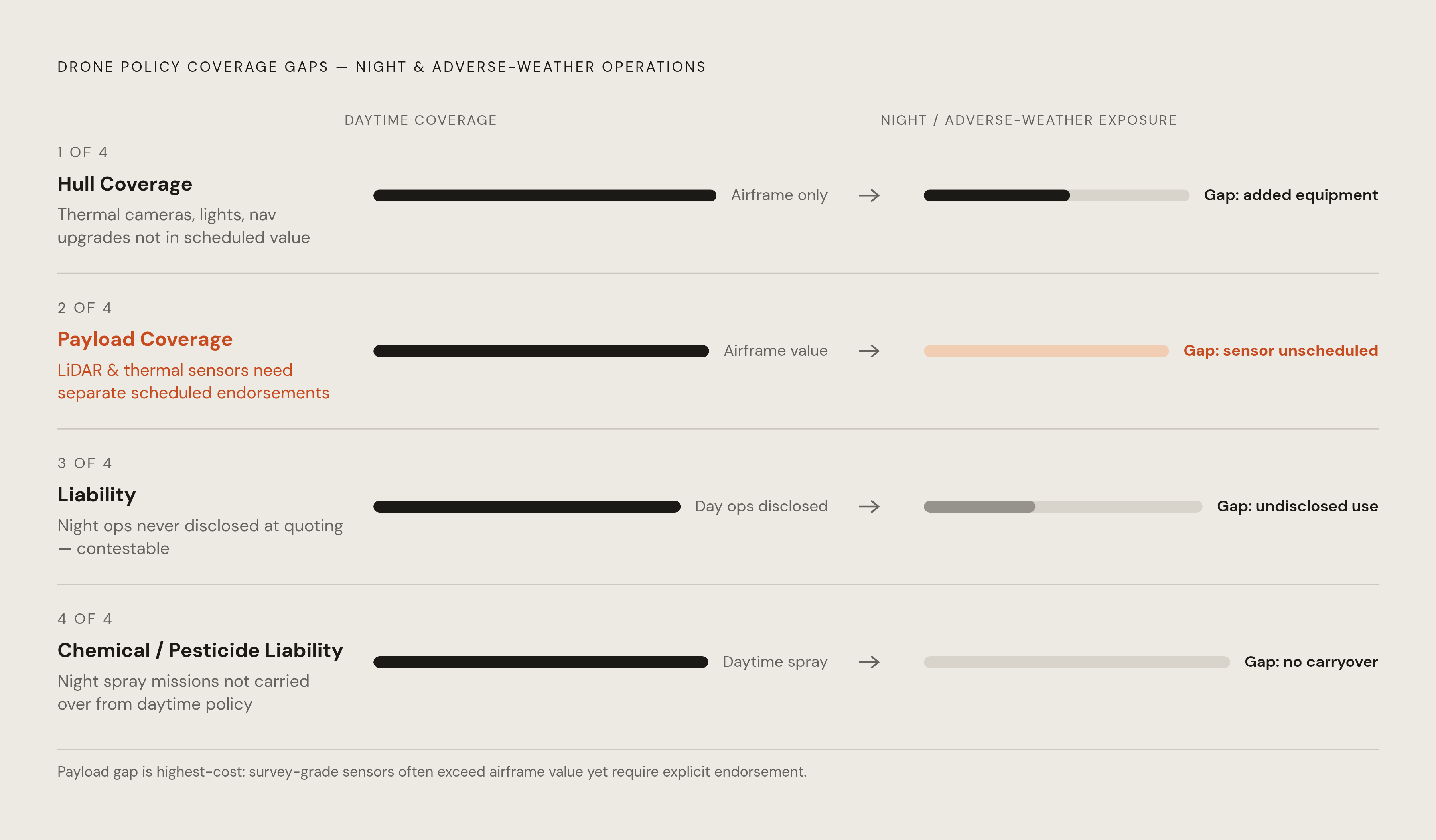
A standard drone policy carries at least four components, and each one fails in its own specific way once conditions shift from daytime VFR to night or adverse weather: hull coverage, payload coverage, liability, and, for agricultural operators, chemical or pesticide liability.
Hull coverage protects the airframe itself, valued and described as it was at the time the policy was quoted. An operator who adds equipment afterward, thermal cameras, specialized lighting, an upgraded navigation system, without updating the scheduled value on the policy, will find that the replacement cost after a crash exceeds what the insurer agreed to pay. Hull policies typically cover the drone frame, propulsion system, gimbal, and cameras that are permanently attached, but removable payloads like thermal cameras and LiDAR sensors usually need a separate scheduled endorsement. Operators running night missions with removable specialized sensors sit squarely in the group most likely to discover that gap only after a loss has already happened.
Payload coverage is a related but distinct problem. A survey-grade camera or thermal imaging sensor can be worth several times what the airframe itself costs, and a default hull policy simply doesn't cover it. Payload coverage needs to specify whether equipment is protected during transit, storage, and active flight, and for night or adverse-weather missions, active flight is the moment of highest risk, which is exactly when coverage gaps matter most.
Liability coverage is what most clients and municipalities actually require before they'll authorize a flight at all; the large majority of commercial clients ask for proof of insurance before work begins. If night operations were never disclosed when the policy was quoted, an insurer can contest a liability claim from a nighttime incident on the grounds that the operational profile submitted didn't include it. The policy covers what the operator represented at quoting, not whatever the operator later chose to fly. Night operations in congested areas and adverse-weather BVLOS missions increasingly require proof of coverage as a condition of authorization, so a gap in the policy is both a financial exposure and a compliance failure.
Chemical and pesticide liability is its own line item, separate from hull and general liability, and some agricultural drone policies include it while others treat it as a bolt-on extra. An operator running spray missions at night needs to confirm explicitly that the policy covers chemical drift or application errors during those nighttime runs. Coverage for daytime spray operations does not extend automatically to the same work performed after dark.
Autonomy, Signal-Dependency, and Coverage Gaps in Degraded Conditions
Drones flying at night or in low-visibility conditions are disproportionately likely to be operating autonomously or semi-autonomously, and that introduces a set of liability questions that standard aviation liability forms were never written to answer.
In degraded RF environments, whether caused by rain, interference, or distance, losing the data link between aircraft and operator is a primary risk. Software-driven return-to-home behavior is a designed mitigation for exactly that scenario, but it's also a decision the aircraft makes without real-time human input. That shifts liability away from pilot error and toward how the operator's system was designed and configured, a distinction most commodity policies aren't built to price.
GPS spoofing and cyber exposure sit in the same category. AIG's unmanned aircraft systems coverage includes an optional extension for hijacking or spoofing, protecting against unlawful seizure or wrongful exercise of control through signal manipulation, an endorsement most commodity policies don't include and most operators don't think to ask for. Cyber coverage in this context has to be built to cover bodily injury and physical damage resulting from a cyber-attack on a vehicle in motion. Standard cyber insurance is written for data breaches, not for a drone losing control and falling out of the sky.
As autonomy increases, the human piloting the aircraft in real time plays a smaller role, and accountability for a loss event shifts from pilot judgment toward system design. Product liability and technology errors and omissions coverage matter alongside aviation liability. Manufacturers and component-part suppliers already face liability exposure for alleged defective design, manufacturing defects, or failure to warn. Operators deploying third-party autonomous systems at night or in weather sit in the middle of that liability chain, exposed to claims that originate from a part they didn't build but chose to fly.
What the regulatory authorization stack means for coverage validity
An operator's regulatory authorization status is part of the risk profile the underwriter priced when the policy was written, and operating outside that authorization can void the policy.
Commercial night operations under Part 107 require either a night waiver or anti-collision lighting visible from at least three statute miles. An operator flying at night without the right documentation in place may be operating outside the scope of the policy without realizing it, right up until a claim forces the question.
BVLOS operations raise the bar further. The proposed Part 108 framework would require applicants to submit a communication assessment and a ground risk assessment acceptable to the FAA, and that documentation is likely to become what underwriters ask for as a condition of quoting advanced operations going forward.
Operations over people and in congested areas at night increasingly require proof of coverage as a condition of authorization. Regulatory requirements and insurance requirements are converging, so a gap in one creates a gap in the other. Layered on top of the federal rules, certain municipalities require their own permits and insurance for operations over public property, and cities with active construction or filming markets often carry specific requirements an operator has to satisfy before a certificate of insurance will even be accepted. State requirements vary widely too: North Dakota, for instance, carries no state-mandated insurance requirement at all, a sharp contrast to states and municipalities that impose their own minimums. An operator's obligations can shift considerably just by crossing a state line.
How enterprise and government contracts embed coverage requirements that night and weather operators fail to meet
Contract insurance requirements are where coverage gaps stop being theoretical and become immediately visible. An operator who discovers the policy doesn't cover nighttime operations at the moment a client asks for a certificate of insurance has already lost the job.
Standard enterprise requirements typically include general liability coverage with a minimum per-occurrence limit, an additional insured endorsement naming the client, a certificate of insurance delivered before work starts, and hull coverage for operations performed over sensitive property. Real estate companies, construction firms, and government agencies ask for this documentation as a matter of course, and for night or adverse-weather work, a policy that doesn't explicitly cover those conditions may fail to satisfy the requirement even when the dollar limits themselves are high enough.
Government and prime contracts raise the floor further. Most government contracts specify minimum limits per occurrence and in aggregate across general liability, technology errors and omissions, and cyber coverage, and some prime contracts set limits well above the standard commercial baseline. Businesses using drones for BVLOS and autonomous flights may also be required to carry higher liability coverage, demonstrate risk mitigation strategies, maintain detailed flight logs and incident records, and run regular safety audits, obligations that go well beyond what a standard policy relationship typically produces.
The additional insured endorsement sits at the center of this problem. Naming a client as an additional insured extends the policy's protection to that client for the specific work being performed, but if the underlying policy doesn't cover the actual operating conditions, night flying, adverse weather, the endorsement provides no real protection regardless of what it says on paper. A policy adequate for a client's daytime work is not automatically adequate for that same client relationship once the operation shifts to conditions the policy was never written to cover.
What a policy that covers nighttime and adverse-weather operations looks like
A policy built for nighttime and adverse-weather operations is a purpose-built submission that describes the actual operation being performed and gets placed with a carrier whose policy form is written to cover it.
That submission starts with the operational profile itself. Underwriters need a clear picture: aircraft types and values, payloads in use (thermal cameras, LiDAR, multispectral sensors, specialized lighting rigs), mission types, geographies, flight frequency, crew size, and every regulatory approval in place, night operations authorization, operations-over-people approval, BVLOS waivers. Night flying added after a policy is already in force, without notifying the insurer, creates a coverage gap on its own. Disclosure has to happen at quoting, not after a loss has already occurred.
Hull coverage needs a scheduled value that matches the aircraft's actual equipped configuration, including whatever removable payloads it carries on that mission. Payload coverage needs separate scheduled endorsements for thermal, LiDAR, multispectral, and other high-value sensors, since removable equipment of this kind often requires its own equipment coverage or item-level endorsement. Liability limits need to match the highest requirement found in any active client contract, carry additional insured capacity where clients require it, and explicitly cover the operating conditions, night, weather, BVLOS, under which the work actually happens. If agricultural operators run night spray missions, they need chemical and pesticide liability confirmed explicitly rather than assumed to carry over from daytime coverage. Cyber and spoofing endorsements need confirmation wherever signal manipulation or data-link loss is a credible risk, since standard cyber exclusions in commodity policies apply by default without an explicit endorsement written in. And technology errors and omissions coverage alongside product liability matters for any operator running autonomous systems that make decisions without real-time human input, a combination that enterprise and government contracts are asking for with increasing frequency.
None of this changes what makes a drone operation valuable: the thermal inspection completed before sunrise, the agricultural spray window that only opens after dark, the BVLOS survey flown through weather a daytime-only policy would never have anticipated. It changes what has to be true about the paperwork behind that operation before the aircraft takes off, so that the policy an operator is counting on actually holds when a claim arrives.