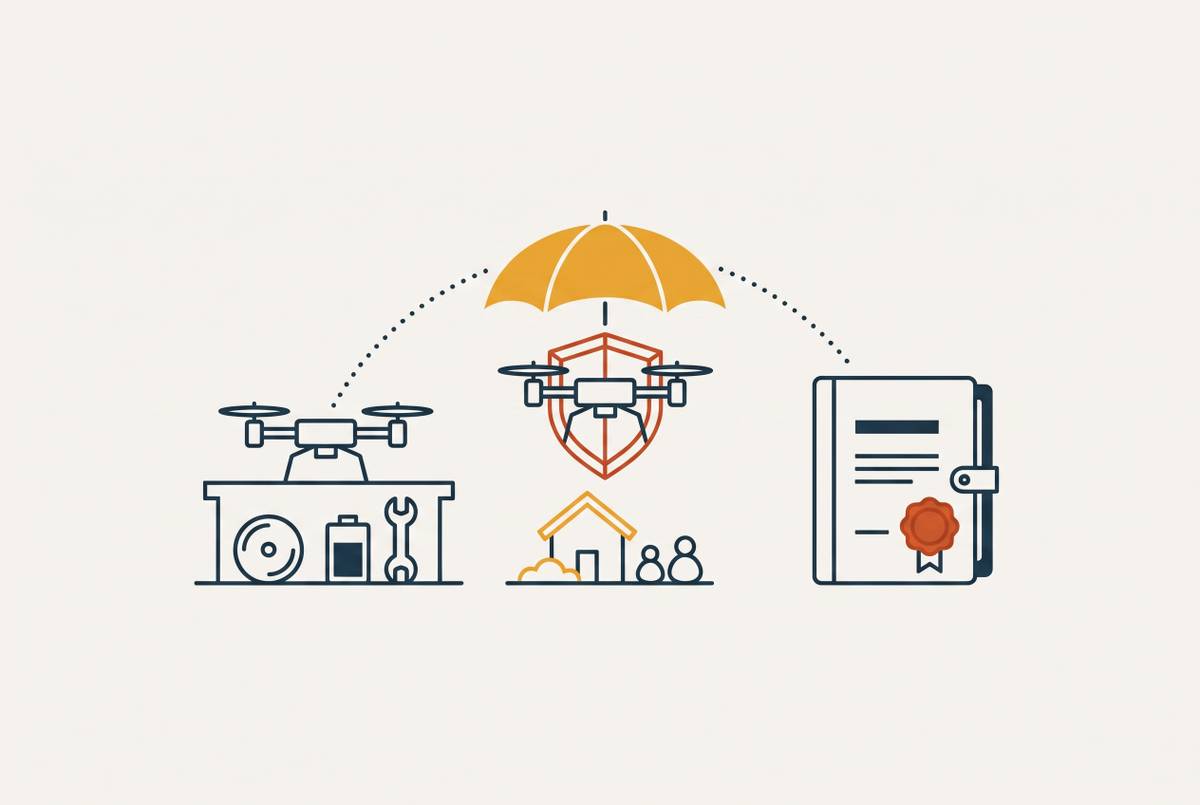
Enterprise Drone Insurance Certificate Requirements
Enterprise clients, not federal rules, set the insurance bar for commercial drone operators.
The FAA does not require insurance for commercial drone operations under Part 107. No federal mandate exists for either recreational or commercial pilots, and that absence is the starting fact of this entire article. At least one state, Minnesota, requires commercial operators to carry an annual liability policy under statute 360.59, but that is a state-level exception, not a federal baseline. Because federal regulators have left the question open, the people actually setting the insurance bar for drone work are construction firms, utilities, government agencies, and logistics operators who write their own requirements into service contracts and site access agreements. An operator can hold a clean Part 107 certificate, fly a spotless safety record, and still get turned away at the gate of a job site because the certificate of insurance in hand does not satisfy the client's risk team.
What a certificate of insurance is and what it cannot do
A certificate of insurance is a one-page summary issued by an insurer, agent, or broker that lists the policy type, coverage limits, effective dates, the named insured, and contact information for the carrier. It reports the shape of a policy. It does not change that policy, add new coverage to it, or bind any party who isn't already part of the underlying agreement.
A certificate proves that a policy exists and that, on paper, it meets the conditions a client has asked for. It says nothing about whether a specific future claim gets paid, because that question is answered entirely by what the underlying policy says, not by what the certificate summarizes. Enterprise procurement teams treat the COI as a gate: they check limits, check endorsements, check additional-insured status, and a certificate that fails any one of those checks stops the deal before it starts. A certificate built from the wrong policy, say a standard general liability form with an aviation exclusion buried in it, hands a client false assurance. When a claim actually happens, the exclusion in the policy controls the outcome, not the summary document the client filed away during onboarding.
Why a standard GL policy will not produce a valid COI for drone work
Most commercial general liability policies carry explicit aviation exclusions covering bodily injury and property damage tied to the ownership, maintenance, or use of aircraft, and these policies do not carve out unmanned aircraft from that language. A Part 107 operator running a generic GL policy is, for the purposes of the actual flying, uninsured.
Picture the failure mode directly: a drone clips a utility line during a routine inspection flight, triggers a power outage, and damages equipment on the ground. The GL carrier reviews the claim, finds the aviation exclusion, and denies it. The operator is now personally exposed to the full cost of that outage and the damaged equipment, with no policy standing behind the loss. An operator who lists that same GL policy on a certificate and sends it to a sophisticated enterprise client is betting on one of two outcomes: either the client's risk team catches the exclusion and rejects the certificate on the spot, or the client misses it, signs off, and only discovers the gap when a claim comes due and the carrier walks away from it.
Because enterprise clients set the real bar, an operator needs a policy built specifically for drone operations, not a generic commercial general liability form with an aviation exclusion tucked inside it. Specialists like Risklytics work with carriers that write dedicated aviation liability policies for unmanned aircraft, so the coverage actually lines up with what a client's procurement team checks for on the certificate. The right baseline is a dedicated aviation liability or UAV liability policy written for unmanned aircraft from the start, not a GL form with an endorsement bolted on after the fact.
Payload and sensors add a second exposure that often goes unnoticed. Hull coverage protects the airframe itself, but if cameras, LiDAR units, or thermal imagers are mounted on the drone, that hull policy does not automatically cover them. They need separately scheduled equipment coverage, and a certificate drawn from a hull-only policy will never show that it exists.
The coverage stack enterprise clients check on a COI
Dedicated aviation liability sits at the base of the stack. It covers third-party bodily injury and property damage from drone operations, and without it as the lead policy, a certificate will not survive a professional review by anyone who knows what they're looking at.
Hull coverage protects the aircraft itself against crash, theft, and flyaway, and clients in asset-heavy sectors increasingly want it as proof that the operator has real financial stake in flying safely, not treating the aircraft as disposable.
Payload and sensor coverage has to be scheduled separately from the hull policy, because the hull policy covers the airframe and nothing attached to it. An operator running thermal imaging or LiDAR mapping equipment needs that equipment listed on its own schedule and reflected on the certificate; leaving it off understates the real value of the operation being insured.
Cyber liability covers an exposure that's easy to overlook on a flying machine: drones collect, transmit, and store data in flight, which opens the door to unauthorized access, GPS spoofing, signal jamming, and data breach. Losses from those events are typically excluded from standard drone policies unless a dedicated cyber endorsement or coverage extension is added. Some carriers, AIG among them, offer spoofing and hijacking coverage as a separate add-on rather than folding it into a cyber endorsement, and data-sensitive clients in construction, infrastructure, and government increasingly ask for this line by name.
Tech E&O, or professional liability, matters when the thing being delivered is data rather than a flight: maps, surveys, inspection reports. An error in survey output can trigger expensive rework or stall a project outright, and clients whose decisions depend on that data will want this coverage confirmed before they rely on it.
Personal injury and invasion of privacy coverage fills a gap that standard drone liability leaves open: bodily injury and property damage are covered, but claims over invasion of privacy, defamation, or slander tied to captured imagery are not, unless it's added as its own line. Clients working in sensitive environments increasingly require it.
Non-owned UAV coverage protects an operator who flies rented, leased, or borrowed equipment, and enterprise clients contracting with operators who use third-party platforms want confirmation that the liability follows the operation itself, not just the aircraft the operator happens to own.
How limit requirements scale by sector
A per-occurrence minimum that covers basic commercial drone work is where the conversation with an enterprise client starts, not where it ends. Construction site operations commonly call for per-occurrence limits well above that baseline. Energy sector work typically asks for substantially more than that, and operations near critical infrastructure or in high-risk industrial environments can push the number higher still. Government contracts often specify a minimum per-occurrence limit of their own, but utility and infrastructure clients frequently exceed that minimum by a wide margin and may add a hull coverage requirement on top of it.
An operator carrying only a minimum limit who wins a contract demanding more sits in one of two uncomfortable positions. So the bid gets lost once the certificate goes through review, or the operator proceeds anyway, holding a contractual liability exposure that could pierce corporate protections the moment a real claim arrives. Limits also are not fixed across a single client's entire portfolio of work. A utility company might set one limit for a routine visual inspection and a much higher one for a BVLOS corridor flight over transmission infrastructure, so an operator has to know which clause in the contract governs which flight before assuming a single number covers the whole relationship.
The additional-insured requirement
Enterprise clients want more than proof that an operator carries insurance. They want to be named on the policy itself as an additional insured, so that the operator's coverage extends to cover claims brought against the client that arise out of the operator's work.
That status has to be added to the underlying policy by endorsement and then reflected on the certificate. A certificate that lists a client as an additional insured without that policy endorsement sitting behind it offers nothing real: that gap between certificate and endorsement is what produces the exposure, because the carrier owes that client no coverage at all, regardless of what the certificate says. Many enterprise contracts go further and specify the exact endorsement language required, terms like "ongoing operations," "completed operations," or both, and a certificate carrying generic language instead of that specific wording can get rejected by a client's legal or risk team even when the dollar limits are otherwise correct. This is where deals stall at the last minute, often after every other box has been checked.
Some enterprise and government clients also want advance written notice before a policy is cancelled or materially changed. That notice requirement, too, has to be endorsed onto the policy and confirmed on the certificate. An operator whose coverage lapses mid-contract without that notice having been triggered can find themselves in breach of the agreement, independent of whether the lapse was intentional or an oversight.
State law and municipal permitting layered on top of enterprise contracts
Enterprise contracts are not the only source of obligation here. States and cities write their own insurance requirements into commercial drone filming permits, airport-proximity rules, and municipal contract terms, no matter what a client eventually negotiates.
Some cities require proof of insurance before they will issue a commercial filming permit. Minnesota, through statute 360.59, is currently the only state that mandates insurance coverage for commercial drone operations outright, which makes it the sharpest example of a jurisdiction imposing a requirement before any client contract is even on the table. Municipal contracts frequently set their own minimum coverage amounts, and these can differ from whatever an enterprise client has separately negotiated for the same job. An operator flying across multiple states carries a compliance burden that spans every jurisdiction touched, not just the one where the business is domiciled: the policy and the certificate both have to satisfy the most demanding requirement in play, wherever the flights happen to occur.
Government work adds its own platform-level complication. Federal and state agencies increasingly restrict which drone manufacturers are acceptable for government contracts, and that restriction shows up on the certificate the same way any other coverage requirement does, as a condition the operator has to satisfy before the contract moves forward.
Underwriting submissions and whether the right COI is obtainable
A certificate only ever reflects what a carrier agreed to cover. An operator cannot produce a certificate showing five-million-dollar limits and a cyber endorsement if the carrier never agreed to write those terms in the first place, and that decision rests entirely on what the operator submitted during underwriting.
Underwriters are evaluating the operator, not just the hardware. FAA Part 107 certification, advanced certifications, documented flight hours, a safety management system, standard operating procedures, and claims history all factor into whether a carrier offers higher limits and at what premium. A submission built around a specific operation, describing the aircraft, the sensors, the mission profile, the airspace, and the operator's qualifications in language an aviation underwriter actually recognizes, consistently produces better terms than a generic form written for a conventional small business.
The gap between what a standard GL policy appears to cover and what it actually covers is the exact problem dedicated drone liability insurance solves. Risklytics places policies written specifically for unmanned aircraft operations with carriers that explicitly carve unmanned systems out of their aviation exclusions, and that distinction shows up directly on the certificate, in language that holds up under an enterprise client's review. A broker who reads the enterprise contract before drafting the submission knows which limits, endorsements, and additional-insured language need to appear on the resulting certificate, and builds the submission around those requirements from the start rather than placing a standard policy and trying to retrofit it afterward. Risklytics works this way directly: an operator describes the operation in plain language, a licensed broker drafts the submission from that description, and the submission goes to carriers who explicitly cover autonomous and unmanned operations, so the certificate that comes back is one an enterprise client will actually accept.
Reading an enterprise contract's insurance exhibit before going to market for coverage
Enterprise contracts and government solicitations typically include an insurance exhibit or schedule that lays out the required coverage lines, the per-occurrence and aggregate limits, the endorsement language, and the notice-of-cancellation terms. Reading that exhibit before buying or renewing a policy is the single most consequential step an operator can take in this entire process.
The exhibit has to be the input the broker works from, not a checklist applied after the policy is already placed. If it calls for a five-million-dollar aviation liability limit, a specific additional-insured endorsement, and a cyber rider, those three things need to be in the submission brief before a carrier is ever approached. The common failure runs the other direction: an operator buys annual coverage at standard limits between contracts, a high-value opportunity shows up, and the existing policy can't be endorsed mid-term to meet the new requirement without triggering a material change and a full re-underwriting, sometimes with no time left to finish that process before the contract gets awarded.
Building the coverage stack proactively, at the limit and endorsement tier that matches the kind of client an operator is actually targeting rather than the bare minimum its current contracts require, closes that gap before it opens. Building the right coverage stack takes understanding how limits, endorsements, and additional-insured language interact on the certificate itself, and confirming that the underlying policy was drafted with enterprise procurement standards in mind. Brokers who specialize in autonomous hardware placement, Risklytics among them, read the actual policy language before binding, so they can confirm that every field on the certificate reflects coverage that genuinely exists. A specialist broker who understands both the aviation liability market and the contract requirements enterprise and government clients impose can map an insurance exhibit against what's actually available in the market and tell an operator, before the bid goes in, whether the required certificate is obtainable, what premium range to expect, and how long placement will take.