Part 107 Compliance and Insurance Policy Alignment
Part 107 certification alone won't protect you from coverage gaps and exclusions.

FAA Part 107 governs how commercial drone operations are conducted. It does not require insurance, define coverage types, or provide any liability protection, and operators who earn their certificate and assume they are covered are exposed from their first commercial flight. Part 107 establishes a regulatory baseline: pilot certification, aircraft registration, operational limitations, Remote ID compliance, waiver conditions for anything outside standard operating rules. None of those requirements transfer liability protection to the operator when a drone damages property, injures a bystander, or crashes into something expensive. The FAA leaves commercial drone insurance entirely unmandated. The mandate comes from clients, property owners, and project owners, and from the underwriting assumptions that carriers quietly build into every policy they write for a Part 107 operator. Those assumptions, that the operator is certified, that flights comply with FAA rules, that required waivers are in place, that operations are properly documented, govern whether a claim gets paid, even though none of it appears in the language of the policy jacket itself.
The standard general liability policy's aircraft exclusion
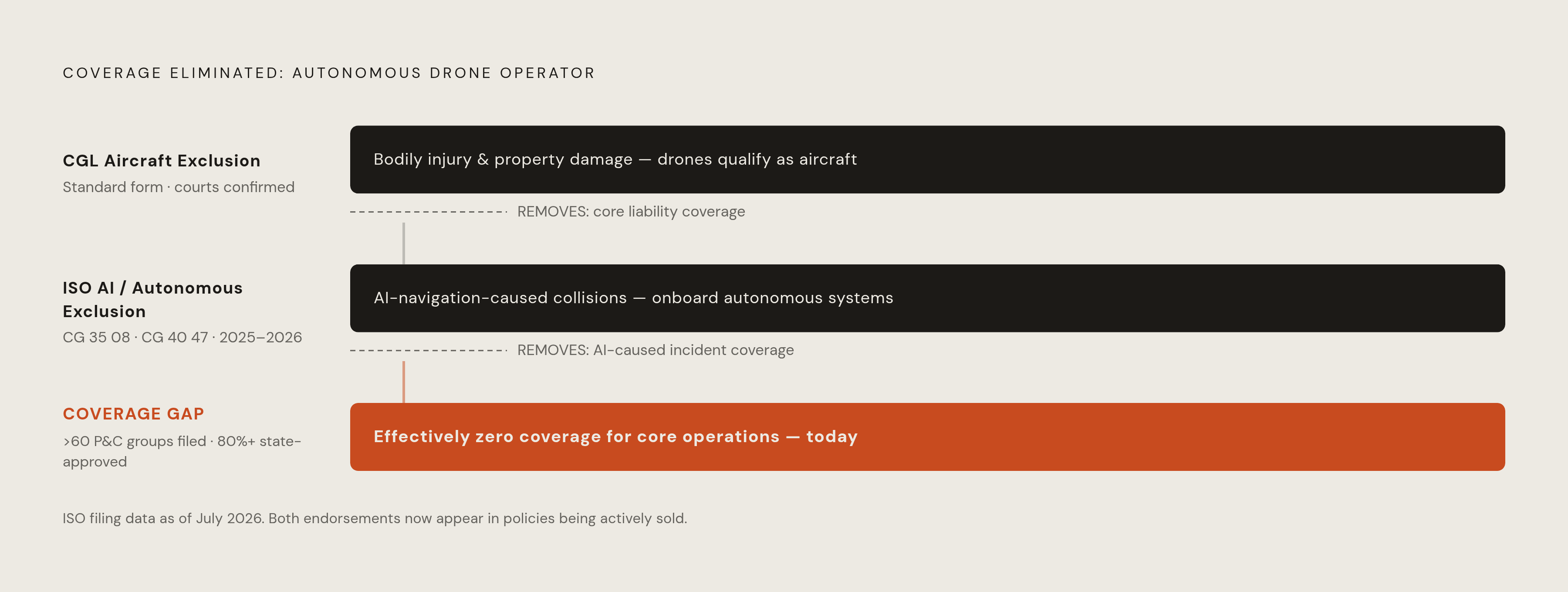
The most immediate coverage trap for Part 107 operators sits in a deliberate exclusion. Standard commercial general liability policies carry an aircraft exclusion, and it removes coverage for bodily injury and property damage arising from the ownership, maintenance, or use of any aircraft. Courts have already ruled that drones qualify as aircraft under that exclusion language, so a CGL policy an operator buys as baseline liability protection can exclude the exact operation the business depends on. Picture the loss pattern that BWI Aviation Insurance describes as foreseeable for Part 107 pilots: a drone clips a power line during a roof inspection, damages HVAC equipment below, and the operator's CGL carrier denies the claim on aircraft exclusion grounds. The exclusion itself is not new. Operators encounter it after the loss because it appears nowhere in the broker's pitch, on the certificate of insurance, or anywhere in FAA documentation. The fix is aviation-specific liability coverage written explicitly for UAS operations, not a standard CGL that carries an unstated assumption that drones get treated as ordinary equipment. Finding a carrier willing to write that coverage, and making sure the submission describes the drone's role and waiver conditions precisely enough that the underwriter's baseline assumptions match the operator's real flight profile, takes the kind of specialist placement work a broker focused on autonomous systems provides.
The 2026 wave of AI and autonomous systems exclusions
Operators flying drones with AI-directed flight modes, automated obstacle avoidance, waypoint navigation, computer vision-based landing, now face a second exclusion regime stacked on top of the aircraft exclusion: the 2025-2026 ISO autonomous systems and AI exclusion forms. ISO form CG 35 08 removes bodily injury and property damage coverage arising from generative artificial intelligence under the Products/Completed Operations Liability Coverage Part of standard CGL policies, and a drone flying a pre-programmed inspection route on onboard AI navigation can fall squarely within that language. ISO form CG 40 47 removes bodily injury, property damage, and personal and advertising injury arising from generative AI, so if a drone's flight computer makes a decision that ends in a collision, the exclusion's language can reach the claim. More than 60 property and casualty insurance groups had filed AI-related exclusions with regulators as of July 2026, including filings from AIG and Great American Insurance, and state regulators had approved more than 80 percent of those requests. These exclusions are already embedded in policies being sold to operators right now. An operator flying a modern drone with autonomous features under a policy carrying both an aircraft exclusion and a CG 35 08 endorsement may have effectively no coverage for the operation that defines the business, a gap that becomes visible only when a broker working specifically with autonomous hardware operators reads the policy language against the drone's actual flight capabilities and operational scope, rather than accepting a generic placement at face value. The way out of that bind runs through the underwriting submission itself, and through how precisely an operator's compliance records get translated into it.
Part 107 compliance documentation as underwriting evidence
Loss data for autonomous and AI-directed drone operations remains sparse, so underwriters cannot price these risks off actuarial tables. They price off governance documentation, operational controls, and the quality of what an operator discloses about how the aircraft actually flies. The assumptions underwriters build in silently, that certification is current, that waivers are in place, that flights are documented, that Remote ID is active, function as coverage conditions. A claim that reveals any of those assumptions was false can be denied on misrepresentation grounds, independent of whatever exclusion language sits in the policy. A submission that describes autonomy level vaguely, omits safety logs, or fails to specify waiver conditions for night or BVLOS operations gives an underwriter no factual basis to exclude the broadest autonomy exclusion forms, so the carrier attaches them anyway or declines to write the policy. A submission built on current Part 107 certification, documented LAANC authorizations, active Remote ID compliance, specific waiver conditions with their operational constraints, and flight logs demonstrating adherence to those constraints gives the underwriter grounds to write the policy without the broadest autonomy exclusions attached. Underwriters do not publish what they assume about an operator's Part 107 status, waiver conditions, or documentation practices. Those baseline assumptions sit buried in underwriting guidelines and surface only when a claim gets denied. Brokers who specialize in autonomous hardware, among them Risklytics, read those assumptions into the submission itself, turning the operator's compliance posture and operational scope into language that makes alignment visible to the carrier from the start.
Coverage lines a Part 107 operator needs, and their compliance requirements
A properly structured Part 107 commercial insurance program draws on several coverage lines, and each one requires a different set of compliance inputs to bind correctly and pay claims cleanly.
- Aviation liability, the UAS-specific replacement for the CGL policies that won't cover drones, covers third-party bodily injury and property damage from drone operations, and requires the submission to establish that the operator holds a current Part 107 certificate, that operations fall within the certificate's authorized scope, and that any deviation such as night flight, BVLOS, or operations over people is covered by a documented waiver.
- Hull coverage protects the drone itself against crash, theft, or loss, and BWI Aviation Insurance describes physical damage coverage as a standard component for Part 107 commercial operators. Underwriters tie hull coverage directly to registration status, since Part 107 requires registration of every commercial drone regardless of weight, and an unregistered aircraft is a red flag that can void the hull claim.
- Payload coverage protects cameras, LiDAR, thermal sensors, and other mounted equipment, and many standard policies do not automatically include it, so operators flying high-value sensors need to confirm payload coverage separately. Payload descriptions in the submission must match the equipment actually flown, since a claim for a LiDAR unit not listed in the application can be denied on that basis alone.
- Specialized endorsements cover non-standard operations: night flight, BVLOS, indoor flights, operations over people, and complex environments each require either a waiver or a specific compliance condition under Part 107, and each requires a matching endorsement or underwriting acknowledgment written into the policy itself.
Enterprise and government contract requirements and the NDAA supply-chain layer
For most commercial Part 107 operators, the practical insurance mandate never comes from the FAA. It comes from the contract, and the contract treats compliance status and insurance status as co-equal conditions of site access. Clients in construction, real estate, and infrastructure inspection require a certificate of insurance before allowing operators on site, and an operator who cannot produce one quickly loses the job to a pilot who can. Government contracts add a supply-chain condition, and no insurance policy can substitute for it. Since September 3, 2026, DFARS clause 252.240-7994 reaches a drone's flight controllers, radios, cameras, gimbals, and software, complementing FAR 52.240-1, which has been in effect since November 12, 2024, with operating and funding bars active since December 22, 2025. Both provisions implement a federal supply-chain security law, and a non-compliant drone fleet cannot be used on a federal contract no matter how well-structured its insurance program is. If an operator's drone hardware fails that supply-chain compliance standard, the operator needs to resolve that before the insurance conversation even starts, because no policy language fixes an equipment disqualification written into a federal procurement rule.
Treating the compliance file and the insurance submission as independent checklists
The most dangerous position a Part 107 operator can occupy is one where the compliance documentation and the insurance submission are each technically complete but describe two different operations. The FAA file shows what the operator is authorized to do. The insurance submission shows what the carrier agreed to cover. Neither document reflects what the operator actually flew the day the incident occurred, and that gap stays invisible until a claim forces it into view. Underwriting assumptions, that certification is current, waivers are in place, flights are documented, Remote ID is active, are not checked at bind time. They get checked at claim time, when the carrier pulls the operator's FAA records, waiver history, and flight logs and compares them against the submission that was used to price the policy. A discrepancy between the submission's description of operations and the FAA record of how the aircraft was actually flown, a night operation not covered by a disclosed waiver, a BVLOS flight the submission described as VLOS, an aircraft model missing from the registration, gives the carrier a factual basis for denial that has nothing to do with exclusion language. None of this requires bad faith on the operator's part. A submission drafted generically by a broker unfamiliar with Part 107 operations will use language that appears to cover the operation but does not, a failure of precision in the description. A submission built from accurate compliance documentation, current certificate, specific waiver conditions and their operational constraints, aircraft registration numbers, payload schedules, flight log summaries, gives the carrier an accurate picture of the risk and gives the operator a defensible claim position when a loss actually occurs.
Building an insurance submission that reflects actual Part 107 operations
The remedy for every gap described above is a submission that describes the operation completely: aircraft, autonomy level, waiver conditions, airspace authorizations, payload, operational environments, and the governance controls already in place. A submission built for real Part 107 operations needs several specific inputs. The current Part 107 Remote Pilot Certificate and its recurrent training completion date belong in it, since pilots must complete recurrent training every 24 months to maintain currency. It also needs aircraft registration numbers for every drone in the fleet, matched against the hull schedule in the policy, since each aircraft must be individually registered under Part 107. Active waivers and their specific conditions need listing: night operations, BVLOS, operations over people under Category 1 through 4 conditions, restricted airspace authorizations through LAANC. Remote ID compliance status matters directly, since enforcement is active as of 2026 and non-compliance carries civil penalties, and a carrier reviewing a claim will check whether the aircraft was broadcasting at the time of the incident. Payload schedules listing every camera, sensor, or instrument flown commercially, with values attached, prevent the unlisted-equipment denial described earlier. Whether a CG 35 08 or CG 40 47 endorsement attaches to the policy at all depends on the autonomy level description: which flight modes are used, what onboard AI or automated systems are active, and whether any operation runs without continuous pilot input. Flight log summaries that show the operational pattern match the claimed scope round out the file.
A generic broker working from a standard commercial aviation form will not ask for most of this because standard forms were never built for Part 107 operations and don't prompt for waiver conditions, autonomy levels, or AI flight mode disclosures. A specialist broker reads the policy before it binds, checking whether autonomy exclusion forms are attached, whether the aircraft exclusion in the underlying CGL has been addressed, whether waiver conditions align with the coverage scope, and builds the submission from the operator's actual compliance documentation rather than from a generic description of commercial drone services. Risklytics works with companies building and deploying frontier technology, including robotics, autonomous systems, AI software and agents, drones, hardware, space, and defense, in the field and in production. It reads every policy before it binds and constructs submissions from what operators actually do rather than from what a standard form assumes they do. The commission is already built into the premium whether or not a specialist places the policy, so the cost of getting the submission right is no different from the cost of getting it wrong, except at the moment a claim gets filed.