Pre-Revenue UAV Startup Hull and Liability Placement From First Prototype to Binding
Insurance coverage must evolve as a UAV startup moves from prototype to customer operations.
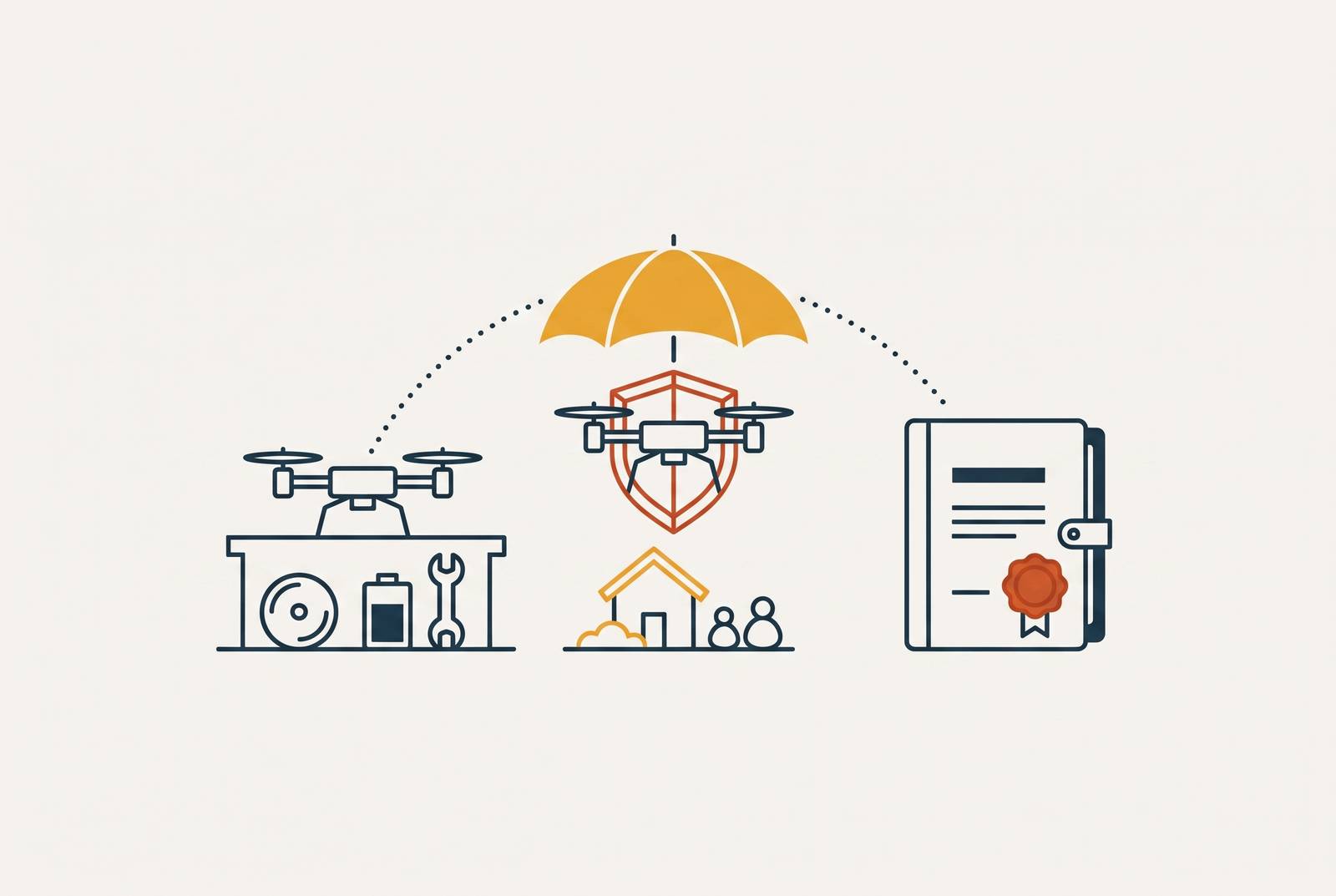
Pre-revenue autonomous vehicle and drone startups can get insurance, but placement must track what they do from prototype testing through customer pilots to binding. For a UAV startup, the decisive issue is whether the submission and policy describe the actual aircraft, autonomy, regulatory authority, and loss exposures. Coverage holds together through specialist placement and explicit policy terms.
Why a pre-revenue UAV startup cannot treat insurance as a single transaction
A founder with a first prototype faces an immediate question about protecting an aircraft that is ready to test but not ready to sell. Buying insurance may look like one more task before flight. The underwriter sees a developing operation instead. Its test boundaries, software, equipment values, and eventual customer obligations will change, so an application adequate for one stage may not describe the next.
The market is well-developed for standard recreational and commercial flights, but less mature for autonomous, BVLOS, and AI-directed operations. Meanwhile, enterprise and government customers can ask for insurance whether or not the startup can get that protection for its operation. A policy can therefore satisfy the founder’s sense of preparedness while excluding the activity that defines the business.
The five coverage lines a UAV startup needs and what each one actually does
Hull coverage is designed to cover physical damage to the aircraft, including crashes, hard landings, flyaways, and mechanical failures, subject to its terms. It may cover ground risks alone or in-flight operations. Valuation is the first major structural choice. Agreed-value policies use the insured figure, while actual-cash-value policies subtract depreciation, potentially leaving a substantial shortfall on a prototype. Payloads such as LiDAR sensors and thermal cameras typically require separate listing.
Flyaways expose another weakness in hull wording. Many low-cost policies exclude GPS or radio signal losses unless the insured can prove there was a mechanical defect. A missing aircraft leaves no evidence of cause. Consequently, a policy designed to cover aircraft damage may still leave a disputed loss when the aircraft cannot be recovered.
Third-party liability addresses bodily injury and property damage. Standard business general liability policies almost always contain an aircraft exclusion, creating a need for aviation-specific protection. Customers and venues require liability coverage, and utility, construction, and government engagements frequently demand higher limits and additional-insured status.
Tech E&O addresses software-driven failures that cause a customer financial loss. A navigation or autonomy stack failure can therefore create an exposure that standard GL does not address. Physical damage is not the only loss. For a startup whose software is the product, customer-facing operations require protection designed for that economic exposure.
Inland marine or equipment coverage covers ground infrastructure that airframe policies often leave out. Control stations, docking hardware, LiDAR ground units, and base stations can represent significant capital, particularly in BVLOS operations. Their location creates a separate coverage question. Identifying them independently prevents the airframe’s insured value from being mistaken for protection of the whole operating system.
Cyber liability addresses breaches, hacks, and unauthorized access to mission data. Yet a cyberattack causing property damage can fall between a property policy’s cyber exclusion and a cyber policy’s property damage exclusion. The five lines must therefore fit together. Separately, funded startups also face a board-level exposure addressed by D&O, where broad AI exclusions can remove protection for claims involving AI use, deployment, or development.
What the AI exclusion wave of 2026 means specifically for UAV policies
ISO, the Verisk standards body whose forms underpin most commercial general liability policies, introduced optional AI exclusions with a January 2026 edition date. These began attaching at CGL renewals from January 1, 2026. Renewal is therefore a coverage decision. An apparently familiar program may move AI exposure into an exclusion, a sublimit, special conditions, or a separate endorsement that must be requested.
CG 40 47 excludes bodily injury, property damage, and personal and advertising injury arising out of generative AI. CG 40 48 excludes only personal and advertising injury, leaving bodily injury and property damage coverage unaffected by that endorsement. The distinction is important but limited. The narrower form does not establish that an aircraft’s physical operations are covered under the rest of the policy.
CG 35 08 targets the UAV exposure more directly. From January 2026, it takes coverage for property damage caused by autonomous systems, robotics, and AI-directed physical operations out of the products/completed operations coverage part. Delivery drones and self-directing vehicles fall within the operations described. An additional-insured endorsement cannot bring back coverage that this exclusion takes away.
These forms are optional. Their presence must be established from the proposed wording rather than inferred from a carrier’s name or a renewal notice. Specialist placement consequently requires more than finding a willing insurer. It requires identifying which exclusions apply and whether the insurer will agree in writing to protection for the disclosed operations.
How BVLOS operations change the underwriting conversation and what carriers look for
BVLOS is the largest premium driver in 2026 because operating beyond visual line of sight changes the probability and severity of third-party claims. Specialty annual premiums for BVLOS delivery operators can reach $8,000–$40,000+, depending on the account. Aircraft values, operating territory, fleet size, authority, and safety controls determine the risk being priced.
Until there is a final Part 108 rule, carriers price BVLOS operations case-by-case, and test operations use case-by-case waivers. A pending framework is not current operational authority. The submission must state which Section 44807 or Part 107 authority applies, how that differs from plans for Part 108 compliance, and what limits the operation must follow.
Underwriters also look at pilot training, flight hours, incident history, and the decisions the autonomy stack makes without human input. Fail-safes explain how the operation addresses failure, while software version control explains whether its behavior may change after policy issuance. Both belong in the underwriting account. Unclear waiver descriptions can hold up placement because the insurer cannot clear up doubts about the startup’s regulatory authority for it.
How to get liability coverage for a drone startup at the prototype stage
A startup can get prototype-stage coverage before it has commercial revenue. It does need evidence that the proposed tests represent a manageable and accurately described risk. Founding-team credentials, prior test documentation, remote pilot certificates, engineering backgrounds, and program experience give underwriters a basis for evaluating an operation without a production fleet or commercial record.
Prototype hull coverage is available when the insured value and test parameters are documented. A one-of-a-kind aircraft may have no market comparables, so its agreed value requires underwriting assessment. Liability is also achievable at prototype-appropriate limits through drone-specific or aviation-specific wording, including CGL with an aviation endorsement. Standard GL alone leaves the aircraft exclusion unresolved. Payload and ground equipment can be scheduled when identified separately.
The safety case must describe the tests themselves. Underwriters need to know where flights occur, how often, under what authority, and within which geographic and operational limits. Unmanned prototype flights may use Section 44807 exemptions, and the submission must name the actual authorization as well as the general type of test flight. RTL protocols, geofencing, and kill-switch capability explain what happens when something fails.
These details help answer fair questions about equipment the underwriter does not know. Separate values for the airframe, payload, and ground equipment make the proposed protection legible, while clear test boundaries define the exposure. A poor first submission creates avoidable friction. That friction can persist when the startup later asks the same market to consider broader operations.
The pilot-program stage: when a customer contract arrives before coverage is in place
The first enterprise or government pilot contract can expose several gaps at once. The prototype program’s terms may fall short when a customer asks for higher liability limits, additional-insured status, and certificates before first flight. The timing creates pressure to sign prematurely. Some contracts also expressly require autonomous, BVLOS, or AI-directed operations to be covered, while Tech E&O requirements may reflect the customer’s business interruption exposure.
A Midwest tower-inspection contractor illustrates the cost of discovering this mismatch at the contract stage. His existing policy did not meet a utility client’s higher contractual requirement, and his annual premium increased by roughly 135%. The change came from the required limit. It was not driven by his flying history, showing how commercial obligations can reshape the insurance cost independently of operating experience.
Additional-insured status extends protection to the customer for the specified engagement, but only within the underlying policy’s coverage. It cannot repair an autonomous-operations exclusion such as CG 35 08. Limits also require a separate underwriting decision. A lower per-occurrence limit cannot simply become $5M on short notice without approval and potentially a new submission.
Any obligation the existing policy cannot satisfy needs to be identified, with endorsement work or new placement initiated before contract execution. A certificate delivered promptly does not solve a policy that was never written for the promised operation.
The pre-binding stage: what must be true before a carrier will bind coverage for autonomous operations
“Autonomous” does not explain which decisions the aircraft makes, what sensor redundancy exists, or what happens when the system fails. The underwriter needs those distinctions stated plainly. Software version controls and the process for reporting material changes must also explain how the disclosed operating profile will remain accurate after binding.
Airframes, payloads, and ground equipment each need their own scheduled values, and each operation needs to state its regulatory basis and its geographic and altitude limits. Pilot and operator records must show their certificates, training, flight hours, and incidents. If there have been no losses, the submission must say so.
The proposed wording then needs an AI exclusion audit. That review must identify CG 35 08, CG 40 47, or equivalent state-filed exclusions and establish whether the carrier has agreed in writing to carve back protection for the startup’s specific operations. A favorable quotation is not enough by itself. The policy terms must address the exposure described in the submission.
Specialist market activity demonstrates that autonomous systems are an insurable category. Binding remains dependent on the particular operation, the submission, and the terms the insurer agrees to write.
An accurately described operation can later diverge from its submission through changes in software or operating limits, creating a basis for claim denial if those changes are not reported. Binding therefore requires a reporting process as well as a snapshot. The final gate is passed when the insurer understands both the present operation and how changes will be disclosed.
Why submission quality is the variable that determines premium, coverage, and whether the policy holds at claim time
Submission quality controls what the underwriter can assess. A generic description may send an autonomous operation into forms written for crewed or remotely piloted aircraft, leaving its defining exposure unanswered. Market selection compounds that problem. A broker using only familiar standard markets may never reach programs written for autonomous operations, regardless of how quickly a certificate can be produced.
Specialist placement requires the startup’s operational documentation. A licensed broker should understand the autonomy stack, regulatory authority, safety case, and insured values, then read the proposed policy and flag gaps before binding. Broker commission is already included in the premium. Using a specialist broker for this placement costs the insured nothing beyond that premium itself.
For a pre-revenue UAV startup, getting insured is a navigable process when it begins at the right stage with a submission that makes the operation clear. It gives the insurer a defined risk to accept, subject to policy conditions. The founder’s job is to build the aircraft and describe its operation accurately. The broker’s job is to turn that evidence into an insurance placement written for it.