How Drone-Sector Inland Marine Markets Extended Their Appetite to Cover Autonomous Ground Robot Fleets
Specialty insurers adapted drone coverage frameworks to protect autonomous ground robot fleets.
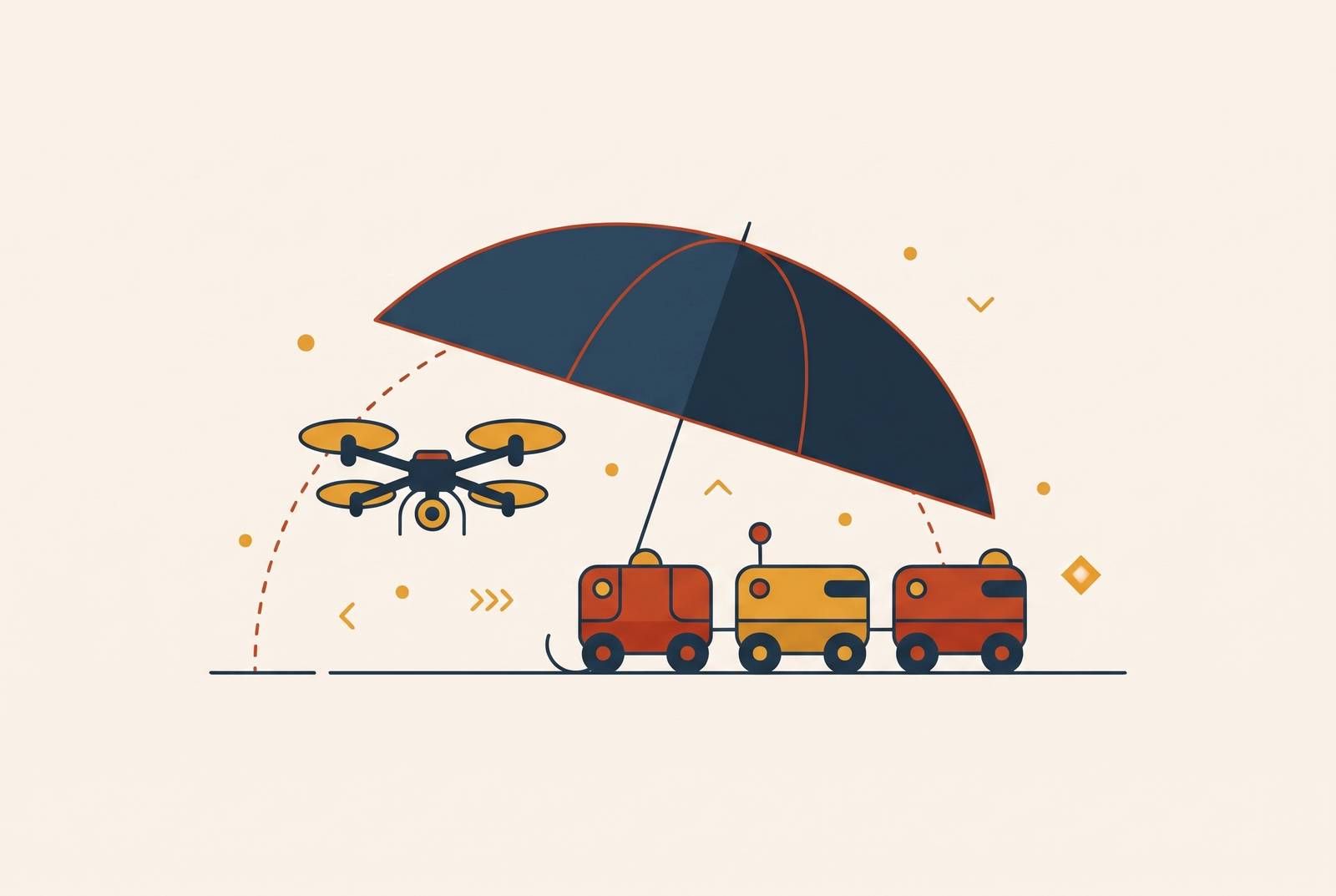
Inland marine coverage for robot fleets in use has a mobile equipment floater that follows scheduled robots between job sites and across the places where they work, under the policy’s terms. Commercial drone underwriting built on that foundation with programs that cover equipment, payload, liability, and cyber protection together. That lineage explains how specialty markets can insure autonomous ground robots, while adding protection for the production downtime that ground fleets introduce.
Why inland marine was the right home for mobile autonomous assets before drones arrived
Standard commercial property and commercial auto leave a gap in coverage for mobile equipment. Property coverage is tied to a scheduled address and its immediate surroundings, while auto coverage protects the truck and trailer, leaving the cargo being hauled outside its scope. A landscaping mini-excavator stolen from a job site exposes that gap. The equipment is away from its fixed premises, and insuring the vehicle that transported it does not insure the excavator itself.
The floater was designed for that separation. Its logic is to schedule the asset, follow it across locations, and price the exposure created by mobility. Manufacturing and construction helped inland marine grow early on because costly equipment often moved between places with different working conditions. Autonomous robots share that basic exposure profile before any question of software behavior arises. Their movement between sites fits an insurance framework already in use, with no need for a wholly new kind of property coverage.
How commercial drone underwriting turned that floater logic into a multi-line specialty program
Commercial drones added exposures that a mobile equipment floater alone could not address. An autonomous asset could move between places, work with different payloads, and cause harm through software behavior as well as mechanical failure. Mobility was only the starting point for underwriting. During roughly 2020–2025, the market moved from one-off liability slips toward annual fleet programs layering hull coverage, payload cover, third-party liability, and cyber add-ons, with pricing informed by telematics.
Payload coverage was a particularly transferable development. A drone fitted with a thermal sensor and a ground robot fitted with a LiDAR stack present the same scheduling problem. A generic floater that schedules only the hull can miss much of the equipment value attached to it, while different payload configurations change what the insurer is being asked to protect.
Behavioral unpredictability also widened the underwriting task. Physical damage and third-party harm could arise from what the system decided to do, from a broken component, or from an operator’s immediate command. A spoofed GPS signal or hijacked control link illustrated the overlap. A cyber event could produce a property loss or liability claim, so separating cyber coverage from physical consequences became harder to justify. Drone programs began dealing with that boundary before it drew much attention in ground robot insurance.
Drone programs developed a multi-line structure while keeping the equipment limit unchanged. Each component addressed a different consequence of operating the asset, while the connections between components became part of the underwriting work. That distinction explains the relevance to ground fleets. Their insurers can build on a framework that already accounts for mobile hardware, changes in payloads, autonomous behavior, and cyber-physical loss.
What distinguishes an autonomous ground robot’s risk profile from a drone’s, and why those differences are manageable within the same framework
Ground robots work at human height in spaces they share with others, including warehouses, sidewalks, and construction sites. They interact directly with people, objects, and infrastructure, creating a different liability profile from most commercial drones. Contact changes the severity of the exposure. The potential damage per incident is generally higher where interaction is direct, and third-party bodily injury becomes a dominant concern. Those differences push liability limits upward without displacing the underlying floater, liability, payload, and cyber structure.
Autonomy also changes the attribution of responsibility. As a system increasingly acts on learned experience, responsibility can migrate from the end-user toward the manufacturer and software developer. This is not unique to ground robots. Drone underwriting addressed the same problem through carefully structured additional insured endorsements and indemnity language. Where the ground fleet works changes how insurers assess it, but policy and contract wording can still spell out who is responsible.
Production dependency introduces a more distinct departure. A wheeled logistics robot or quadrupedal inspection robot that goes offline may interrupt a line or workflow, creating loss beyond the value of the damaged machine. Repair coverage alone does not resolve that exposure. Ground robot programs must therefore account for business interruption that drone programs did not have to price at scale. The framework remains useful because it can add a continuity component rather than treating every consequence as equipment damage.
Inland navigation offers a parallel without erasing these differences. GDV said that insurers were in principle ready to insure automated ships, showing that mobile assets can fit within insurance structures already in use even when they are autonomous.
How the AI exclusion wave in admitted-market policies is pushing ground robot buyers toward the specialty lines that already know this risk
Standard-policy exclusions are making the distinction between available insurance and responsive insurance more important. A company can keep its general liability coverage while losing protection for a specified kind of AI-related injury or damage. The endorsement’s wording determines the boundary. For a ground robot operator, an exclusion reaching AI-directed physical operations can remove protection for the activity that generates the core liability exposure.
ISO’s endorsements need to be read separately. CG 35 08 takes bodily injury and property damage that arise out of generative artificial intelligence out of Products/Completed Operations coverage. CG 40 47 excludes bodily injury, property damage, and personal and advertising injury arising from generative AI systems, including their outputs, recommendations, and decisions. CG 40 48 is narrower in scope. It excludes only personal and advertising injury under Coverage B, so bodily injury and property damage are still covered.
These forms should not be treated as interchangeable autonomous-system exclusions. Their stated focus on generative AI makes the relationship between the wording and the deployed technology essential to the coverage analysis. The perimeter is also under review. Verisk’s ISO said in July 2026 that it was evaluating additional exclusion options specifically for agentic AI. That development extends the discussion beyond the current generative-AI endorsements.
At the same time, affirmative AI coverage in cyber policies may leave the gaps made by exclusions in D&O, E&O, and CGL policies unfilled. The missing protection may concern bodily injury, property damage, or autonomous operation. Policy counts can therefore be misleading. As standard coverage shrinks along these lines, buyers are pushed toward specialty lines that already assess how software behavior can cause physical harm. The drone-derived framework supplies an established basis for that placement.
What insurance covers autonomous robots traveling between job sites, and how do specialty programs reflect the drone lineage?
An inland marine floater addresses the mobile equipment exposure, but a deployed fleet needs more than protection during transit. Specialty ground robot programs bring together coverage for equipment damage, third-party liability, cyber-physical loss, and business continuity for the asset at work. The distinction is between movement and operation. The floater follows scheduled equipment, while the broader program addresses harm caused by the robot and losses created when it stops working.
Tokio Marine & Nichido Fire Insurance announced on October 26, 2026 that it would begin offering “AI Robot Insurance” starting in November 2026. The product is for autonomous mobile robots that have physical AI, including wheeled robots, quadrupedal robots, and humanoid robots that work in a range of settings. Its announced protection includes equipment damage and third-party liability. It also covers business continuity costs, including labor costs for replacement personnel and rental fees for substitute robots during downtime. That component addresses the production dependency that distinguishes ground fleets from typical drone operations.
In specialty coverage more broadly, cyber-physical protection covers physical damage caused when a cyberattack takes over a robot’s controls. Coverage for production losses from a software update or sensor failure without physical damage extends the same logic to software-only shutdowns. Those terms need their own examination. The named launch does not establish that every specialty program includes every cyber-physical or non-damage interruption provision.
The International Group of P&I Clubs stated in July 2026 that liabilities from fully unmanned vessels were poolable under standard mutual P&I arrangements. Where ground robots operate can still leave gaps in coverage. Where AI software is not treated as a product, an injury may not trigger product liability, leaving other liability coverage to absorb more of the exposure than anticipated.
What underwriters reviewing an autonomous ground robot submission actually need, and how the quality of that submission shapes coverage and premium
Specialty underwriters are still developing pricing models for ground robot fleets, making the submission central to the coverage decision. It describes not only the assets but also the uncertainty the insurer must accept. Missing detail has a practical cost. An underwriter unable to distinguish the operating exposure may respond with an exclusion, a margin for uncertainty, or a declination.
The lesson for buyers is to make the fleet schedule operationally specific. Each robot’s model, software version, payload configuration, and operating environment tell the underwriter more about its risks than its equipment value alone. Software governance belongs in the submission as well. A current SOC 2 report, a documented security policy, and a clear data classification map improve confidence in how the exposure is managed. These documents serve a role comparable to flight logs and operator certifications in drone programs.
Document intelligence extracts schedules, serial numbers, and COI details from ACORDs, spreadsheets, and emails, while APIs draw on weather, crime, flood, wildfire, and route data. Other inputs include DOT/FMCSA, OSHA, and permit records, plus consented telematics. A thin submission stands out against that background. External data can describe a location or route, but the buyer’s schedule must still identify the robot, its configuration, and its intended work.
A specialist broker with drone or autonomous-system placement experience can anticipate those questions and organize the submission to answer them. That preparation can shorten the path from submission to bind and reduce gaps caused by an incomplete exposure picture. It does not make all fleets equivalent. Its purpose is to let coverage terms and premium reflect the described operation.
The questions a ground robot operator should ask before the next renewal to confirm their coverage actually covers their operations
Before renewal, the operator’s review should begin with the actual liability wording. The operator should check whether the CGL includes CG 35 08, CG 40 47, CG 40 48, or another endorsement excluding autonomous systems, robotics, or AI-directed physical operations. The forms have different consequences for coverage. The operator should check whether the applicable wording removes bodily injury or property damage protection for the fleet’s work.
The operator should check whether each robot is scheduled under an inland marine floater that follows it across all operating locations, rather than only under property coverage tied to the facility address. Mobility needs explicit treatment in the policy. The operator should also check whether cyber protection extends beyond data breach and network events to physical damage and production losses caused by remote takeover, a software update, or sensor failure. For continuity, the operator should check whether the policy pays for replacement labor and substitute equipment during downtime or pays only for physical repair costs.
Operational conditions require equally precise answers before binding. The operator should ask whether the robot must have a hard-coded kill switch or manual override protocol to be covered and whether the robot in use meets that condition. Autonomy itself needs an explicit answer from the carrier. The operator should ask whether the policy covers fully autonomous navigation and task decisions as well as teleoperated or remotely supervised modes.
Contract requirements provide another test of the placement. The operator should ask which enterprise or government contracts require specific coverage lines or limits and whether the policy satisfies them. A declarations page cannot answer every coverage question. The operator should confirm when a licensed broker last read the actual policy language before binding. If any of these questions cannot be answered with confidence, that is the signal to seek a specialist review.