Payload Liability for Drone Delivery and Cargo UAS
Cargo liability is the missing layer most drone delivery operators discover only after a loss.
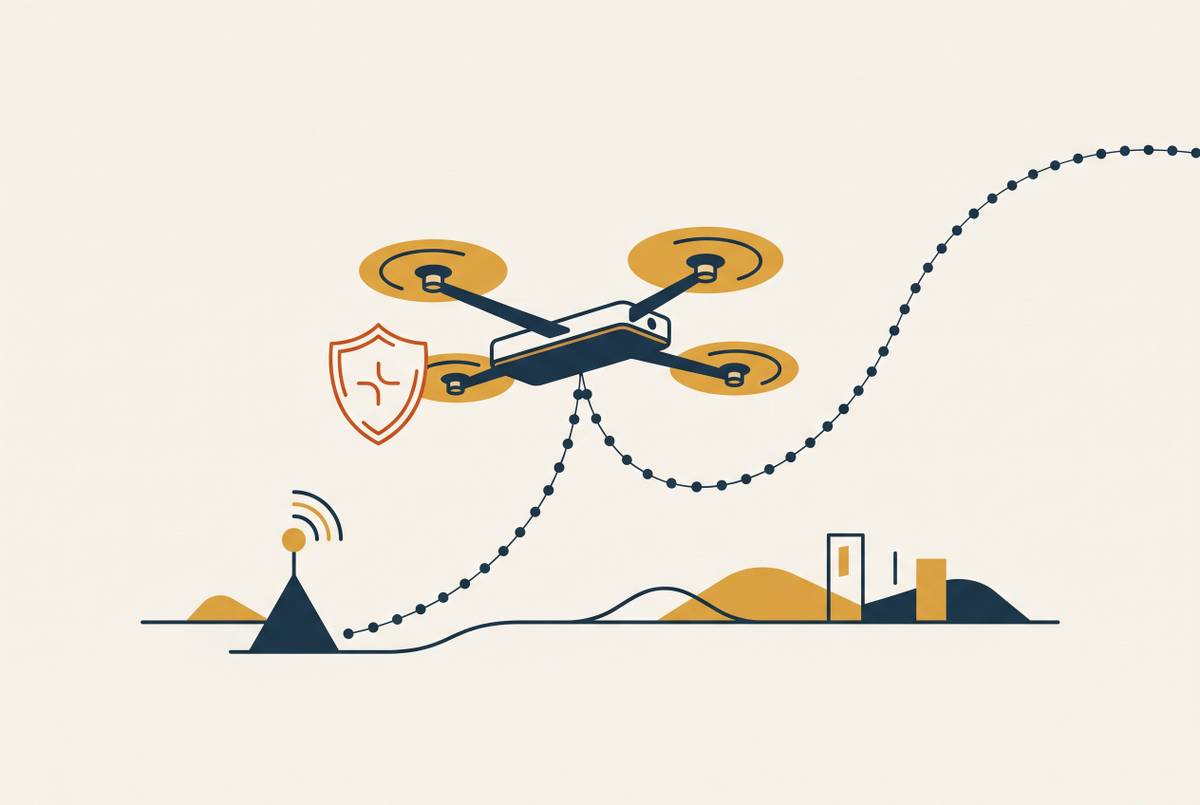
A drone that flies a package over a residential block does something categorically different from a drone that photographs a construction site or inspects a cell tower. There is no pilot holding visual line of sight, often no pilot nearby at all, and the aircraft is carrying something of value that belongs to someone else, moving over homes, driveways, and sidewalks where people have no idea an aircraft is overhead until it either lands or fails. That operational picture creates a three-layer risk architecture: third-party liability for harm the aircraft causes to people or property below, hull or physical damage coverage for the drone itself, and payload liability for whatever the drone is carrying. All three layers have to be addressed at once, yet most commercial drone insurance policies are built to handle only the first two. Regulatory requirements compound the exposure. BVLOS operations and Part 135 certificate requirements add a layer of compliance that changes what proof of insurance has to look like before a single flight is authorized, and the cargo itself often raises the stakes further: pharmaceuticals, electronics, and other essential goods carry a consequential cost when a delivery fails that can exceed the replacement value of the item lost. Aviation underwriters know the third-party and hull layers well, because they have decades of experience pricing aircraft risk. Payload liability is the layer operators most often discover is missing only after a loss has already occurred.
Why general liability and standard aviation policies exclude the payload
The payload gap is the predictable result of how two long-established insurance forms were constructed, each for a purpose that never anticipated cargo-carrying aircraft. Commercial general liability policies contain what the industry calls the aircraft exclusion: virtually every CGL form excludes bodily injury and property damage arising from aircraft operation. A drone delivery company that already carries a CGL policy for its general business operations gets no coverage from that policy the moment its drone leaves the ground. When CGL coverage stops, aviation liability coverage takes over, and it pays for third-party bodily injury and property damage. But its structure mirrors the traditional aviation liability market, built around passenger claims and ground-party claims in an industry where the thing in the aircraft's hold was never the subject of the policy. Hull coverage, though, is what pays when the drone itself is physically lost or damaged. BWI's commercial drone policy language is explicit that this physical damage coverage is optional and applies to the drone and its attached equipment, and payloads may need to be separately scheduled or added depending on the carrier and the specific policy terms. Industry guidance confirms that payloads, including LiDAR sensors, thermal cameras, and cargo, are frequently left out of hull policies entirely and need their own placement. An operator can have a fully placed aviation liability policy and a fully placed hull policy and still carry an uninsured cargo exposure on every single flight, because neither form was ever designed to answer the question of what happens to the thing being delivered.
Cargo liability coverage and its boundaries, including what the named exclusions mean in practice
Cargo liability coverage closes that gap, but you still need to know where its boundaries sit. Coverdrone's cargo liability option, available from January 1, 2026 to commercial policyholders, defines the coverage period with precision: it runs from the moment cargo is accepted until final delivery at its destination or handover to a successive carrier. That precision matters because most cargo losses happen during loading and unloading, so an operator needs to know if those moments fall inside the policy's trigger or outside it. The practical scope of what this covers is concrete. If metal components get damaged on a hard landing, or diagnostic medical equipment gets damaged during loading, the coverage is built to pay for both. But the named exclusions carve out categories that matter enormously to the kinds of goods drone delivery operators actually carry: perishables, livestock, money, jewelry, and precious materials are all excluded from this coverage. If you deliver groceries, fresh produce, or biological samples, the perishables exclusion alone can leave a lot of your cargo value outside the policy. The most consequential exclusion for time-sensitive delivery work is consequential loss. A vaccine that spoils in transit has a replacement cost that is just the vial and its contents, but the actual harm, a missed dose, a delayed treatment, a disrupted medical protocol, is the consequence of the failed delivery rather than the cargo itself, and consequential loss sits outside what this coverage pays. Operators moving pharmaceuticals or time-critical medical supplies need to understand that the thing the shipper cares most about protecting may be precisely the thing the policy does not reach. The coverage also operates on a bailment structure: the insured has to hold legal liability for the cargo under a formal acceptance relationship. If a subcontractor or a gratuitous bailee operates without that formal protocol in place, they may find they never triggered the coverage to begin with. BWI confirms that payload coverage is a distinct component of a drone delivery insurance program, separate from hull and separate from liability, and it has to be placed deliberately because it will not simply exist somewhere in the stack on its own.
Why inland marine fits cargo UAS operations
Inland marine insurance was built for property that moves, cargo in transit, mobile equipment, goods that spend their working life somewhere other than a fixed address, and that makes it a better structural fit for a payload traveling by drone than either a hull policy or a general liability form could ever be. The insurance industry saw this coming well before drone delivery became a commercial reality. In 2016, ISO introduced inland marine frameworks for commercial drones, offering flexible endorsements and underwriting guidance, because mobile, high-value aircraft carrying specialized technology did not fit neatly into any existing form. That was an early acknowledgment of a gap the industry is still working to fill at scale a decade later. In practice, cargo UAS operators typically need a three-part stack to be fully covered: aviation liability for third-party claims, hull for the drone itself, and an inland marine or cargo liability endorsement for the payload. Each piece answers for a distinct layer of the risk architecture laid out at the start of this piece, and none of the three substitutes for either of the others. Inland marine coverage can also extend to ground equipment such as base stations, controllers, and laptops that a hull policy focused on the aircraft typically does not touch. The interaction between these forms becomes clear in a single scenario. If a drone drops a package and the falling package damages a parked car, the claim for the car goes to the aviation liability policy. The lost or damaged cargo itself is a claim under the inland marine or cargo liability form. Damage to the drone from the same incident is a hull claim. Omit any one of the three, and that layer of the loss has nowhere to go.
Coverage lines beyond payload that cargo UAS operators routinely underestimate or omit
Operators who correctly solve the payload gap can still find themselves exposed in places unrelated to cargo. Cyber liability is one of the most consequential blind spots. Autonomous delivery drones are networked assets, relying on GPS telemetry, remote command links, and cloud-based routing systems, all of which make them targets for signal spoofing, unauthorized control, and data interception. Industry guidance identifies cyber and data liability as a growing exposure for any drone operation that collects or transmits data, and that risk intensifies for BVLOS operations, where the command link is the sole connection between the operator and the aircraft in flight. Non-owned and subcontractor coverage is another line that needs deliberate structuring. Drone delivery policies can include non-owned coverage that extends protection to subcontracted drones or delivery partners, and this matters if you run a hybrid fleet or white-label your delivery capacity to a partner brand. Directors and officers coverage rounds out the picture for venture-backed drone delivery companies, because they carry fiduciary duties to investors that no amount of operational insurance can satisfy. A suspended Part 135 certificate or a denied BVLOS waiver is a regulatory setback that can translate directly into investor exposure, and that exposure needs its own dedicated policy line rather than an assumption that general liability or aviation coverage will somehow stretch to cover it.
Enterprise and government contract requirements that exceed what a standard stack covers
The FAA does not mandate drone insurance for Part 107 operations, but that silence does not mean you can fly free of pressure to carry coverage. Enterprise clients and government agencies impose their own requirements, and those requirements often go beyond what a standard commercial drone policy stack delivers. Most clients require proof of coverage before a job begins even when no law compels it, so it works as a de facto mandate across the commercial side of the industry. Standard enterprise contracts typically require a minimum general liability threshold, an additional insured endorsement that names the client, and a certificate of insurance delivered before operations start. Government contracts tend to go further: they frequently require higher limits along with coverage types such as cyber liability or environmental impairment coverage that a liability-only drone policy simply does not include. Client requirements often specify coverage type rather than just a dollar limit, and that specification can decide whether an operator wins or loses a contract. An operator with a strong hull program and solid aviation liability but no cargo liability endorsement can fail a contract compliance review on the payload coverage line alone, even with every other part of the program in good order. The additional insured endorsement deserves particular attention here, because it extends the operator's own policy to cover the client for claims arising from the operation, and that is a materially different commitment than simply holding a policy. Generic policies may not permit this endorsement for aviation operations without specific carrier approval. An operator can discover the gap only when a client's legal team asks for the endorsement and the carrier says no.
Underwriting submissions for cargo UAS versus standard commercial drone applications
Getting the right coverage in place starts well before a policy is bound, in the quality of the underwriting submission itself. Aviation specialty underwriters need far more than a one-page ACORD form for cargo UAS risk, so an operator who submits a generic application will either get declined by specialist markets outright or get quoted terms built for a simpler operation than the one actually being run. BWI names Global Aerospace and USAIG as the aviation insurance companies behind commercial drone policies, and because these are specialist aviation markets rather than standard commercial lines carriers, they apply aviation underwriting discipline to every submission that crosses their desk. That discipline demands documentation: fleet manifests scheduled by serial number, BVLOS waiver status, detect-and-avoid architecture documentation, pilot certification records, standard operating procedures, maintenance logs, and loss history, amounting to something close to an airline's operations manual scaled down to the operator's fleet. A written safety management system and a documented BVLOS risk mitigation strategy tell an underwriter that the operator has institutionalized its risk controls rather than relying on individual pilot judgment alone. Cargo-specific underwriting adds a further layer still, covering the types of goods carried, average cargo value, acceptance and handover protocols, and whether standard operating procedures include cargo inspection at loading, because cargo liability coverage is triggered by a care, custody, and control relationship that underwriters want to see formally managed. A submission built around fleet composition, cargo profile, BVLOS status, telemetry access, and SMS documentation opens markets and terms that a generic commercial drone application never reaches. Because payload liability sits outside standard aviation and general liability forms by design, operators need underwriting submissions that explicitly address all three risk layers, an approach that specialist brokers handling autonomous hardware in the field, Risklytics among them, build into their placement process to make sure carriers writing drone delivery operations are engaged on the full scope of risk before anything binds. The structural gap, a CGL form that excludes aircraft entirely, an aviation liability form that excludes cargo in the operator's possession, a hull policy that leaves unscheduled payloads unaddressed, is why generic broker submissions miss payload coverage so consistently. Brokers who specialize in frontier tech operations read every policy's actual language before submission, so they can find these exclusions and close them during placement rather than leaving them as a surprise at claims time.
A practical checklist for evaluating whether a cargo UAS insurance program covers what it needs to
An operator who has followed the argument this far has the conceptual map in hand, but applying it to a real program requires asking a specific set of questions directly of a broker or carrier, with answers confirmed in the policy documents. The first question concerns payload coverage itself: is cargo explicitly scheduled on the policy or merely assumed to live somewhere inside the hull form, what are the per-item and per-mission limits, and do the goods actually carried fall into the perishables, livestock, or precious materials carve-outs that cargo liability coverage excludes. The second concerns timing: does cargo liability attach from the moment of formal acceptance and continue through final delivery or handover, and is there a gap in coverage during loading and unloading, the exact moments where cargo losses most often happen. The third concerns consequential loss: is it excluded, and if the operator delivers pharmaceuticals or other time-critical goods, what happens when the downstream cost of a failed delivery dwarfs the replacement value of the cargo itself. The fourth concerns the aircraft's mode of operation: does the aviation liability policy explicitly name BVLOS and autonomous operations as covered, or does its language assume a human pilot maintaining continuous visual line of sight, and has that language been confirmed in writing with the carrier. The fifth concerns exclusions buried in other lines entirely: does the operator's CGL policy, tech errors and omissions policy, or cyber policy contain an aircraft exclusion that would void coverage the moment a claim arises from an airborne incident, and has each of those policies been read specifically for that clause. The sixth concerns contract compliance: can the program accommodate naming clients as additional insureds on aviation operations, can certificates of insurance be delivered same-day to new clients, and do current limits meet the requirements of the highest-value contract under pursuit. The seventh concerns the carrier itself: is the carrier that wrote the policy explicitly authorized to write UAS and cargo operations, or did the operator land in a general commercial lines policy that happens to mention drones without underwriting the actual risk. Mapping the precise exclusions, perishables, livestock, money, jewelry, consequential loss, requires a submission built specifically around what the operator actually flies rather than a generic form, and that specificity is what lets a carrier bind payload coverage that genuinely fits the operation instead of coverage that merely looks adequate on paper. An operator who cannot answer every one of these questions from the policy documents themselves, rather than from a broker's reassurance, carries an exposure that will raise its cost at the worst possible time, during a claim. A specialist broker who reads the policies before they bind is the structural safeguard against finding out the answer during a claim.