Multi-Site Robot Fleet Insurance Structures Built the Way UAS Fleet Policies Are Built
Drone fleet policy design offers robot operators a template.
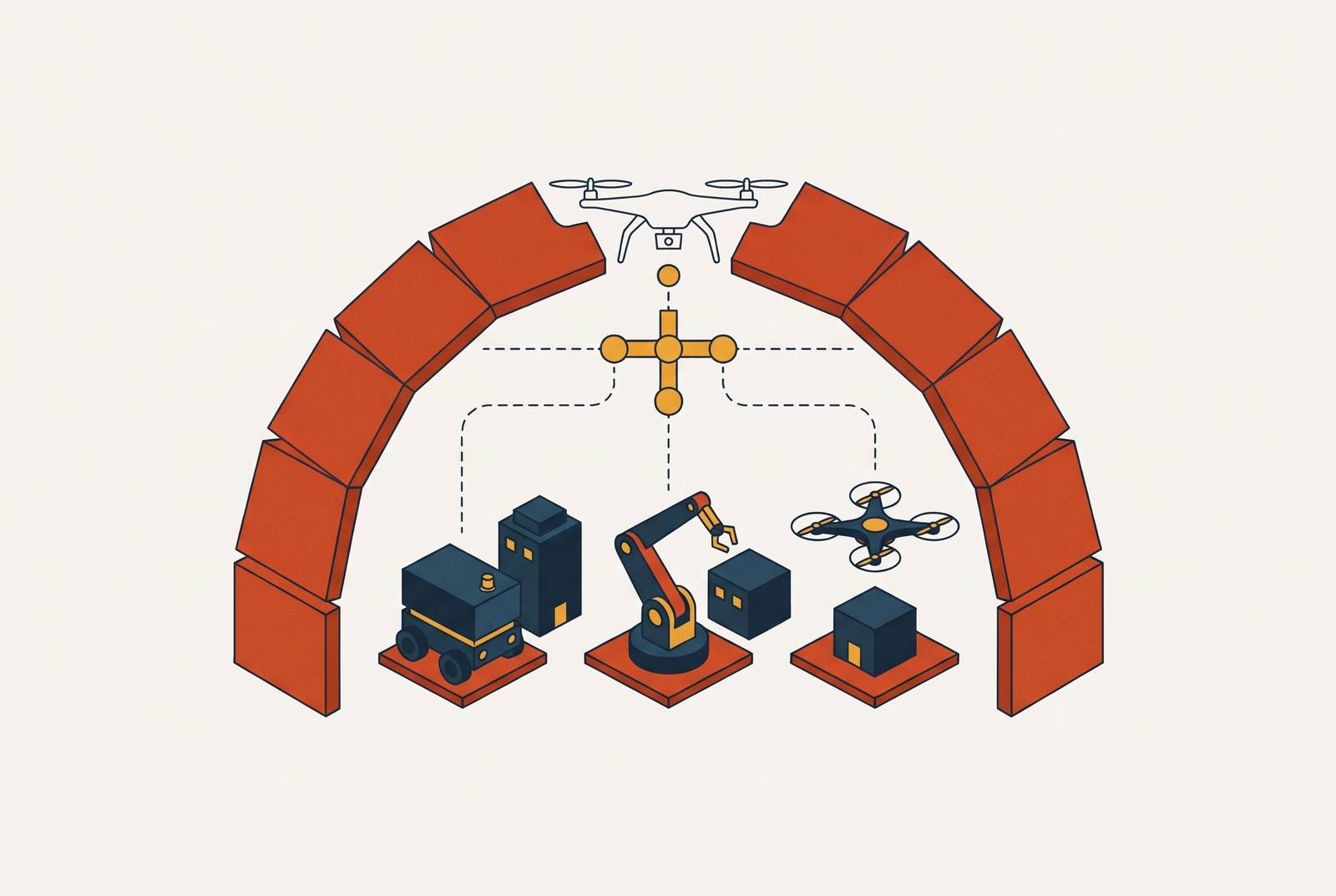
Inland marine coverage insures deployed robot fleets as mobile equipment across job sites, in transit between them, and at fixed deployment locations, subject to the policy’s terms. Operators with robots at more than one site should pair it with a master liability structure based on UAS fleet policies. That architecture solves fleet administration, but autonomous ground robots also require explicit treatment of software failure, cyber-caused physical damage, and operational downtime.
Why UAS fleet policy architecture exists and what problem it solved
Single-aircraft drone policies were not built for businesses that move several aircraft between job sites. Separate policies created coverage gaps and administrative failure as fleets changed and assignments moved. Scale exposed the mismatch between policy and operation. SkyWatch’s 2026 fleet guide describes the resulting architecture, which brings multiple aircraft under one policy with centralized management rather than treating every aircraft as a separate placement.
The response combined a master liability policy, flexible hull limits, scalable endorsements, and on-demand certificates. Higher-value aircraft could receive higher limits, while new units could enter the fleet without restarting the insurance process. Underwriting changed its unit of analysis as well. The operation’s collective loss history and safety protocols drove premium terms.
The five structural elements of a UAS fleet policy
Scheduled versus blanket hull is the first element. Scheduled coverage identifies each aircraft and its insured value individually. Blanket hull covers aircraft in the fleet using the declared total fleet value, with per-unit sublimits. Fleet homogeneity and the pace of changes in fleet composition determine which structure fits.
Tiered hull values are the second element. Different aircraft receive different valuation tiers, with limits set individually. A high-end aircraft with expensive LiDAR or thermal equipment can receive more hull protection than a basic survey unit. SkyWatch’s guide identifies this allocation of premium by unit value as a core feature of fleet structure.
Payload and ground equipment coverage is the third element. It extends hull-equivalent protection to sensors, gimbals, and ground control equipment. Global Aerospace notes that advanced sensors such as LiDAR and thermal cameras can exceed the drone’s own value.
Streamlined endorsements and certificate issuance form the fourth element. Aircraft enter or leave coverage through endorsements to existing policies. Operators can download certificates for individual jobs and manage coverage status through a single dashboard. This administrative structure supports rapid mobilization across multiple sites.
Pilot authorization protocols are the fifth element. They establish which operators can fly which aircraft. Those permissions are internal staffing rules that also affect whether coverage is valid. Unlike equipment valuation or certificate administration, this element depends directly on the relationship between a human operator and the machine.
Where the UAS-to-ground-robot analogy holds directly
An operator deploying autonomous mobile robots, or AMRs, across warehouses faces the same seams that separate aircraft policies created for drone fleets. Separate general liability policies per site divide a connected operation. A single liability tower covering all sites and units provides the corresponding fleet structure.
Tiered hull values also transfer without a conceptual change. A humanoid unit may cost an order of magnitude more than a basic pallet-moving AMR in the same facility. An averaged value fits neither machine properly. Tiering avoids allocating excessive protection to cheaper units while leaving expensive machines underinsured, making valuation differences particularly important in heterogeneous robot fleets.
Streamlined endorsements address the same continuing addition of equipment. Robot operators add units as contracts expand, just as drone operators add aircraft without replacing the whole policy. Inland marine forms accommodate this ongoing schedule management more naturally than standard commercial property forms. They are designed for mobile property, including transportation, mobile equipment, and property at multiple fixed locations. That scope matches a fleet whose machines move between deployments.
Where the analogy breaks down and ground robots demand different treatment
Pilot authorization is the first structural element requiring redesign. A ground robot may operate without a human at the controls, while responsibility may involve software, a remote teleoperator, a site manager, or some combination. Named-human authorization leaves that relationship unresolved. Following an autonomous navigation failure, language tying coverage validity to a named operator can create grounds to contest coverage.
Some UAS policies have exclusions that restrict beyond visual line of sight or fully autonomous flight. Applying that logic to an AMR would exclude its core operating mode. Robot policies must instead replace named-operator language with operational-mode definitions or affirmatively include autonomous navigation. Silence is not a reliable substitute for inclusion.
The master liability and hull framework also needs a broader claims structure. An incident with a manually piloted drone is usually a single physical event, while an AMR loss can involve bodily injury, a navigation algorithm alleged to be defective, and financial harm from software failure. Several coverage lines may respond to one incident. General liability, product liability, and Technology E&O need to work together, so they must be bought with each other in mind. A hull-and-liability structure alone leaves the software-related financial exposure unresolved.
Adding an aircraft changes the equipment schedule, but updating a robot can change its decision logic without changing its physical description. A fleet underwritten last quarter may therefore behave differently this quarter without an endorsement or a mechanism for repricing. Unauthorized control also creates a physical-loss exposure that requires explicit cyber treatment.
A shared update or cloud outage can affect many deployed units across multiple policyholders, an exposure reinsurers have identified as a systemic concern. Tiered hull limits must account for both how much repairs can cost and how much purchase prices differ. Removing human error can make collisions less frequent, but a collision may still call for sensor recalibration, replacement of radar and lidar, and software revalidation. The resulting claim can extend well beyond a conventional physical repair.
How do you insure mobile robots operating across multiple locations?
The recommended stack begins with blanket general liability across all sites. It should cover bodily injury and property damage caused by robotic systems under one policy. This is the direct master-policy translation from UAS. The remaining layers must address the equipment, software, and operational exposures that the liability layer does not reach.
Inland marine should provide the physical-equipment layer for robots at deployment locations and in transit between sites. Schedule high-cost machines at individual values and use blanket treatment for homogeneous fleets of lower-cost units. Include sensors and specialized attachments within the equipment protection. Their value may exceed the base machine’s value, so a robot-only valuation can leave a substantial part of the deployed asset unprotected.
Technology E&O should be a required layer covering financial harm from software or firmware failure, inaccurate AI output, and platform outages affecting enterprise customers. Cyber coverage should explicitly address data loss and physical damage caused by unauthorized control of robot systems. Both need wording fitted to autonomous operations. Product liability should address design and manufacturing defects where the deploying company manufactures the robot or faces a claim as the integrator of a defective third-party component.
Business interruption should complete the stack with triggers scoped to robot downtime. A software update or a sensor that fails can stop production without causing physical damage. Standard physical-loss triggers may not respond to that outage.
What the underwriting submission must carry for a robot fleet policy to price correctly
Choosing the coverage structure is only part of setting the right premiums and terms. UAS fleet underwriting looks at safety records and safety protocols for the fleet as a whole, but underwriters need different information for autonomous robots. Pilot experience says too little about how autonomous robots make decisions. The liability chain may depend on how reliable the sensors are, software version history, the quality of training data, and edge-case validation.
A robot fleet submission should include software version history, the cadence of updates, records of sensor validation, and definitions of the autonomous and human-supervised operating modes. It should also describe each deployment’s floor layout, coworker density, and lighting conditions. Governance around software changes belongs in the same submission because a change in decision logic can alter exposure without adding or replacing equipment.
These records give underwriters a basis for assessing sensor failure, update risk, and accumulation exposure. Without them, a submission describes the machines but not the autonomous operation being insured. That distinction affects both pricing and coverage scope. A submission prepared for specialist markets is better positioned to obtain suitable terms than a generic application routed to a standard general liability market. It also supports the fleet model’s administrative purpose, since slow quotes and narrow coverage undermine efficient certificate issuance.
How enterprise and government contracts set the floor for robot fleet insurance requirements
Enterprise and government customers can require coverage beyond an operator’s baseline program. As with drone contractors, proof of insurance may be a prerequisite for winning work or entering a site. Ground-robot requirements are often less standardized, so the policy must be assessed against the terms of the actual agreement.
The practical review should begin with exclusions and operating modes. A contract requiring general liability is not satisfied in substance by a policy that excludes the robot’s autonomous operation. The coverage name alone is not enough. Autonomous machinery or AI exclusions can create the same basic mismatch that aviation exclusions create for drones under standard commercial general liability policies. Specialists also need to review Cyber and Technology E&O provisions because enterprise customers look closely at those lines when deploying emerging technology.
Additional-insured status, waiver of subrogation, and minimum limits must be reflected in the endorsement structure. Certificate issuance must support those obligations promptly across sites. Operators also need to check local requirements where public-road autonomous vehicle rules apply. California, for instance, requires manufacturers to maintain $5 million in coverage before testing or operating autonomous vehicles on public roads. Operators must verify applicable requirements for each deployment state rather than assume that a warehouse fleet policy settles public-road obligations.
How to evaluate whether a broker can actually place a robot fleet policy correctly
Broker selection should test placement capability. The relevant market is narrower than conventional commercial coverage, policy language is less standardized, and blended claims require more coordination. Technical fluency is part of placement competence. A broker should be able to discuss sensor failure, software update risk, operational modes, and accumulation exposure with underwriters, then translate those discussions into policy terms.
Market access should mean access to specialists that explicitly cover autonomous ground operations. A general market’s failure to exclude autonomy is a weaker basis for placement than affirmative coverage. The distinction should be visible before binding. A broker who defaults to conventional general liability and inland marine forms, or treats Technology E&O and cyber as optional accessories, has not addressed the full structure of the exposure.
Broker commissions are already built into the premium whether a generalist or specialist places the policy, so specialist placement does not inherently add a separate cost relative to generalist placement. The broker should explain compensation and market access plainly. Neither should remain obscure while the operator is deciding who will place the program.
A licensed human broker must read every policy before it binds. That review should establish whether the fleet architecture covers what the autonomous systems actually do. Fleet administration cannot cure an operating-mode exclusion or a missing software-loss trigger. The UAS template succeeds for ground robots only when its administrative efficiency is matched by robot-specific coverage language.