Pre-Seed Coverage Structures for Autonomous Vehicle and Drone Startups Before the First Commercial Flight or Mile
A coordinated mix of coverages keeps pre-revenue autonomy testing from falling into policy gaps.
Insurance for pre-revenue autonomous vehicle and drone startups requires a coordinated coverage structure. Specialist underwriters need data on the technology and how it is used to cover autonomous-system exposures before the startup earns revenue. The central danger is a gap between what the system does and what the policies cover, so equipment, liability, cyber, management, and software coverage must be sequenced around funding, testing, and commercial contracts.
Why the pre-seed window is the most dangerous moment for coverage gaps
Standard commercial policies assume that people operate conventional equipment, while an autonomous startup puts software-controlled hardware into the field. That mismatch exists before the first commercial operation. Test flights and road miles create third-party exposure even when the company has no revenue-driven urgency to formalize insurance. The autonomous system can therefore be the central source of risk without being clearly covered as an insured activity.
This makes the pre-seed period particularly vulnerable to coverage gaps. A navigation model can cause a collision before the startup has a paying customer, and a generic application may never ask how that model operates. Premium comparisons do little to resolve that omission. The policy needs to respond to the activity already taking place, rather than the conventional business category assigned to the company.
Insurers are resolving “silent AI” through exclusions rather than affirmative coverage grants, including exclusions affecting generative AI under products and completed operations coverage. An older policy is not proof that new operations are covered. A founder who treats silence as permission may discover the distinction only when a claim is denied.
How the liability attribution problem makes standard underwriting structurally unable to cover autonomous systems
Traditional underwriting starts with the people who are accountable, but for autonomous systems, underwriters must look at algorithms, software versions, and system design. Driver history and age cannot explain a vehicle’s decisions at SAE Level 4 and above, where operation does not rely on driver intervention in certain driving modes. The information needed to assess that risk is different. At Level 3 and above, software configuration, autonomy status timestamps, and override thresholds become important inputs, yet manufacturers hold data that generic applications do not capture.
An underwriter without the relevant data cannot readily define the autonomous exposure by increasing the limit on a conventional policy. Specialist underwriters instead collect autonomy specifications, data on exposure, and data on how the vehicle performs. Those inputs provide a basis for coverage that reflects the system.
Drone operations reveal a second boundary problem. A command-and-control software breach can cascade to logistics partners, creating a cyber exposure that standard aviation hull and liability policies were not designed to address. A routing error without a breach presents a different question. Both can involve the same aircraft, but the cause of loss determines which coverage line must respond.
The ISO exclusion wave and what it means for a pre-seed autonomous startup's existing or first policy
ISO/Verisk introduced AI exclusion endorsements for commercial general liability policies effective January 1, 2026. Under the products/completed operations coverage part, Form CG 35 08 excludes bodily injury and property damage that arise from generative artificial intelligence and names delivery drones, automated machinery, and self-directing vehicles. The wording requires attention before operations begin. Depending on the governing jurisdiction, an exclusion may reach a claim in which AI contributed to the loss without being its sole cause.
The exclusion trend extends beyond one form. Property and casualty insurance groups have filed AI exclusions for several business lines, and absolute AI exclusions apply to claims that arise from AI used by any person or entity. A vendor’s tools may trigger the wording even when the startup did not develop the AI, and absolute exclusions have also appeared in D&O coverage.
For founders, the practical response is written confirmation of affirmative AI and autonomous-system coverage. A broker’s verbal assurance is not enough. Existing policies need the same scrutiny as first-time purchases because neither their age nor their general description establishes how they treat autonomous operations.
What insurance does a pre-revenue AV or drone startup actually need?
General Liability with affirmative autonomous-system coverage addresses liability from covered operations, but a generic GL form is not sufficient evidence of protection. AI-driven collision must be affirmatively covered. The review must establish whether CG 35 08 is absent or superseded by an affirmative coverage grant. The review must also check coverage for the system’s actions as insured activities and client requirements for additional insured and primary-and-non-contributory endorsements.
Technology Errors and Omissions covers software bugs, algorithmic failures, and errors in AI decision-making. Its job is distinct from general premises liability. For an AV startup, a wrong decision by a navigation model brings Tech E&O into play for the autonomy stack, where product liability and professional services meet. Off-the-shelf wording still needs review for an affirmative AI grant or the absence of AI exclusions.
Inland Marine / Equipment coverage protects property that is mobile or unique, including hardware while it is in transit or at temporary locations. Prototype equipment can represent a significant share of company assets. Sensor payloads, LiDAR rigs, and other test hardware need more protection than standard property coverage gives mobile equipment in the field. This is typically the first physical asset coverage needed.
Cyber addresses security failures such as ransomware, network intrusion, and AI-enabled fraud. It does not generally cover the insured’s own AI output failures. A command-and-control breach and an autonomous routing error thus call for different reviews of what is covered, even when both disrupt drone operations. Tech E&O and cyber are complements.
Directors and Officers coverage protects directors’ and officers’ personal assets against claims alleging wrongful management acts or investor misrepresentation. Funding can make this an immediate requirement. Representations about regulatory compliance or safety can create management liability if later regulatory action prompts a claim. The startup must check D&O wording for absolute AI exclusions before binding.
Standalone or affirmative AI liability coverage fills gaps left between GL and Tech E&O. Munich Re’s HSB subsidiary launched HSB AI Liability Insurance on March 18, 2026, for small and medium-sized businesses to cover AI-related losses that a GL exclusion would otherwise leave unpaid. Specialty markets, including providers at Lloyd’s, also offer standalone products and endorsements that cover model failure and AI output liability. These lines overlap at their edges, and coordinating those boundaries to establish a fit is the specialist broker’s work.
State minimum liability floors and regulatory requirements that set the baseline before any client contract is signed
Operating geography determines the regulatory baseline for public-road AV testing and deployment. California’s CPUC requires $5 million in commercial liability for driverless passenger services, and manufacturers that test on public roads must also provide $5 million through insurance, a surety bond, or self-insurance. The distinction between activities is important for planning. A passenger-service requirement and a manufacturer-testing requirement are not interchangeable descriptions of the same obligation.
Nevada, New Mexico, Maine, Maryland, and Washington each impose a $5 million threshold for testing or deployment. The required coverage is $1 million for on-demand AV networks in Florida and $2 million for commercial deployment in Louisiana. These figures are planning references. They show why a California operating plan starts from a meaningfully different baseline than a Florida on-demand network, rather than from a universal default commercial limit.
Federal legislation has not replaced this state-level framework. The SELF DRIVE Act, H.R. 7390, was introduced February 5, 2026, cleared a House subcommittee by a 12-11 vote, and has not advanced since. For government or federally funded work, NDAA compliance excludes drones manufactured or assembled by a covered foreign entity. Hull coverage on a non-compliant platform does not cure contract disqualification.
Insurance requirements buried in enterprise and government contracts that exceed the regulatory floor
Regulatory compliance does not establish commercial readiness. Enterprise contracts typically specify minimum GL limits, umbrella or excess liability, additional insured status, waivers of subrogation, and primary-and-non-contributory wording. A standard policy cannot be assumed to contain the required structure. The startup must have the required endorsements and layers in place before it signs, with that paperwork completed by then.
Before contractors can fly drones on their properties, corporate clients almost always require proof that liability coverage meets a substantial minimum. Utility and infrastructure clients often require higher limits and may also require hull insurance on the drone. That requirement protects a different interest from third-party liability.
Government and defense work adds obligations inherited from the prime contractor. Those flow-down requirements usually call for Tech E&O and cyber liability on top of the baseline GL, commercial auto, and workers’ compensation coverage. The startup must either delay closing while arranging coverage or accept uninsured exposure under an inadequate structure.
Contract readiness must precede the first enterprise conversation. Additional insured endorsements, umbrella layers, and specialty lines may take more than a few days to put in place. Setting up the coverage early lets the contract spell out the required terms without making the company put the whole program together before a closing deadline.
How submission quality determines whether the coverage a startup gets actually matches its operations
The underwriting submission connects the startup’s actual operations to the coverage the insurer agrees to provide. A generic description such as “technology company” or “logistics operator” leaves the autonomy exposure undefined. The application needs to describe the machine in the field. Technical specifications, exposure data, vehicle or aircraft performance, telemetry, monitoring infrastructure, and software version control give a specialist carrier the inputs needed to price and define the risk.
Feature-level detail also distinguishes autonomous underwriting from an ordinary commercial application. The operating envelope and safety architecture explain what the system does and the conditions under which it operates. Broad business labels cannot perform that work. Ambiguity in the submission leaves room for a disagreement at claim time about whether the carrier understood and accepted the activity that produced the loss.
The submission must also reflect the current operational state. Software updates and usage changes can shift exposure beyond the assumptions of a static risk model, so material operational changes should trigger coverage review. Specialist preparation is not optional administrative overhead. A broker who understands autonomous systems manages the technical submission and reads the policies against it, rather than treating a quoted premium as evidence that the risk has been understood.
That distinction affects both availability and coverage quality. A carrier that does not understand autonomous operations may decline, exclude, or misprice the exposure. A well-prepared submission cannot replace suitable policy wording, but it gives the underwriter a basis for writing it.
The sequencing decision: which coverage lines to secure first and why the order matters
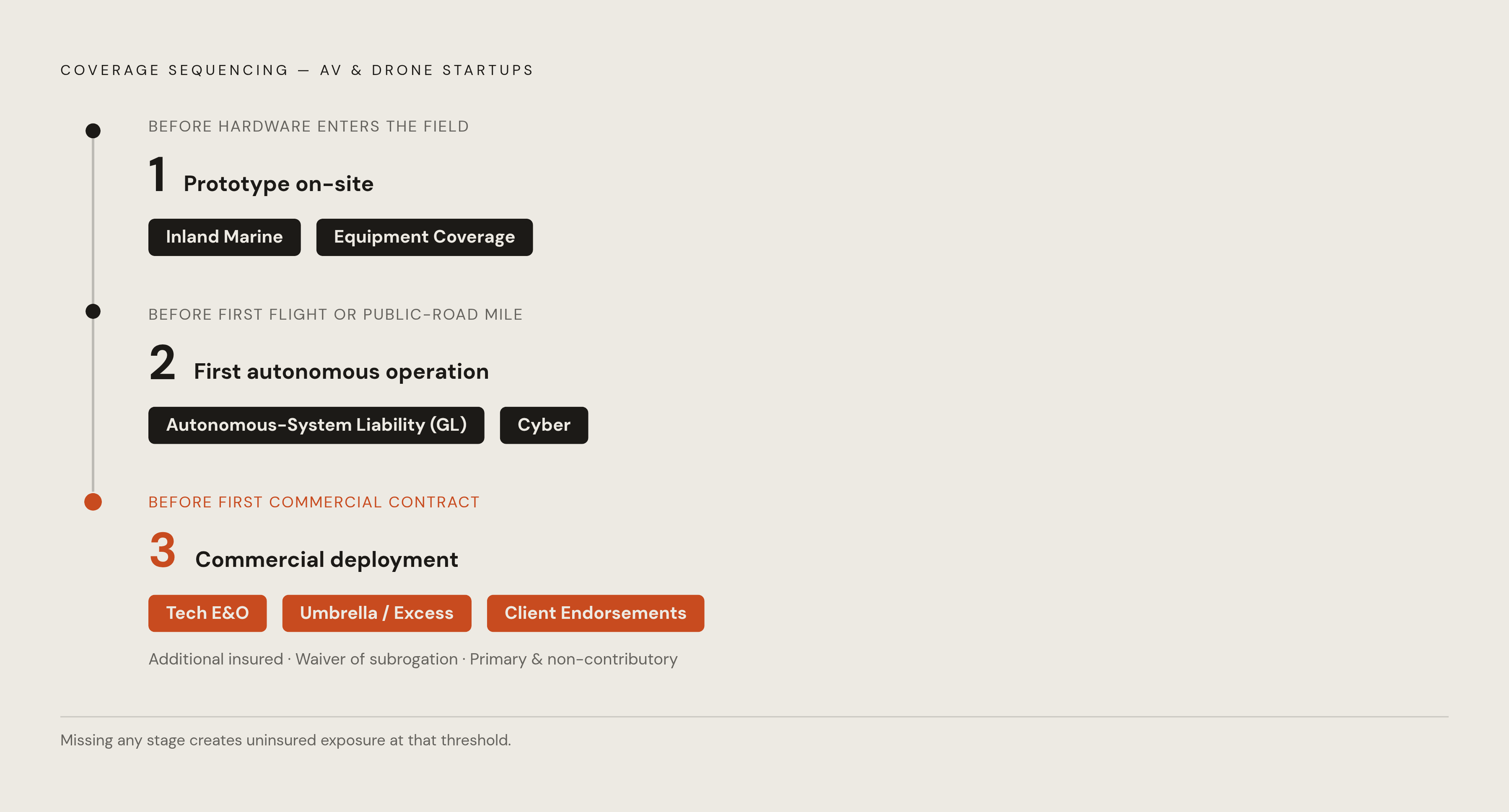
Before prototype hardware enters the field, Inland Marine / Equipment coverage is typically the first physical asset line to arrange. D&O follows the funding timetable. Because investors may require it before or at closing, waiting for a term sheet unnecessarily compresses the review of both management liability and AI exclusions.
Before the first flight or public-road mile, affirmative autonomous-system liability coverage and cyber need to be in place for the activities being undertaken. Testing already creates exposure, and command-and-control systems are already active. The liability structure must fit where and how the startup operates, and cyber must cover the security risks that arise during testing.
Before the first commercial contract, Tech E&O, umbrella or excess liability, and client-required endorsements need to be ready. The order has a practical dependency. Umbrella coverage needs an underlying primary policy, and the startup must plan how its GL structure handles additional insured status, waivers of subrogation, and primary-and-non-contributory wording. Specialty placements must therefore begin before a customer’s deadline makes them urgent.
Affirmative AI liability is assessed after the core wording establishes what GL and Tech E&O actually cover. The pre-seed structure will evolve into the final program, and a sound foundation allows later-stage financing and the first enterprise contract to build on existing coverage.