What Drone Operators Already Know About Equipment Floater Exclusions That Robot Fleet Buyers Are Just Discovering
Drone operators already mapped the exclusions that now trap robot fleets.
Inland marine coverage for deployed robot fleets can cover mobile equipment at multiple locations and in transit, but only within the policy’s equipment definitions, limits, and exclusions. Drone operators learned that a policy that covers movable property may not cover autonomous hardware. Robot fleet buyers can avoid the same losses by placing coverage around what each machine does, where it operates, and how it can fail.
Why drone operators and robot fleet buyers face the same insurance problem
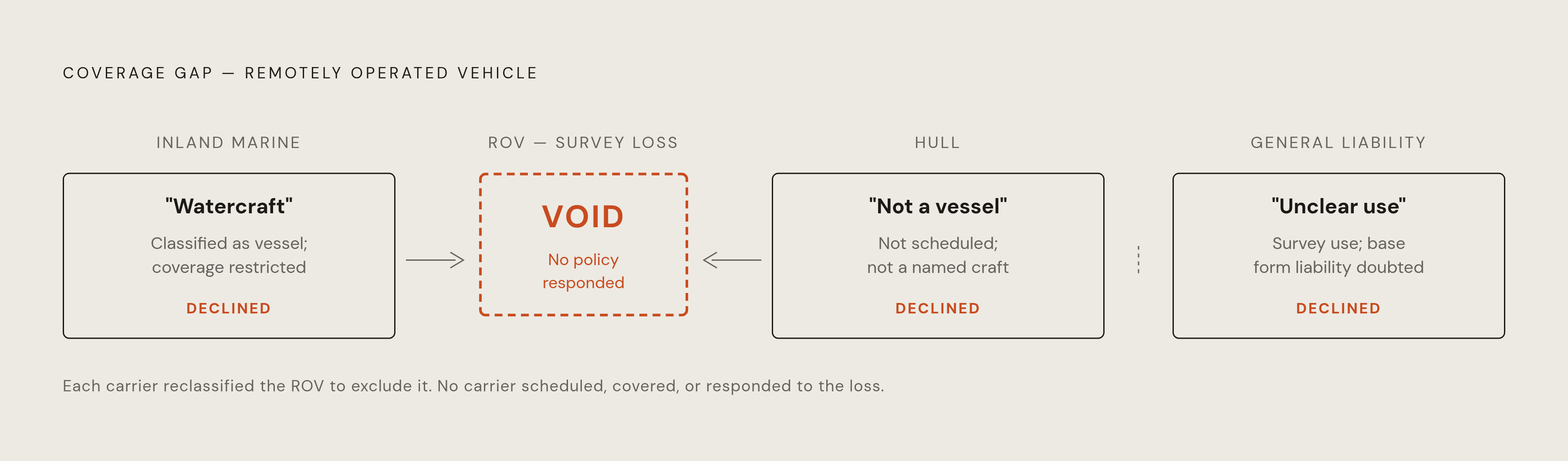
LIG Marine describes a remotely operated underwater vehicle worth hundreds of thousands of dollars that fell between three insurance forms. The inland marine carrier treated it as watercraft, restricted electronic equipment coverage, and excluded the underwater environment. The hull carrier did not consider it a vessel and declined to schedule it. The general liability carrier questioned whether the way it was used created liability that the base form did not cover. When the ROV was damaged during a survey, no policy responded correctly.
The equipment was not an isolated exception. LIG Marine notes that dozens of marine contractors operate the same equipment, while the forms have not caught up. That is the structural link between marine equipment, drones, and ground robots. Each needs insurance in a market built around older types of equipment, so buyers find that the machine fits their business more easily than it fits a policy.
How the inland marine equipment floater was built, and what it was never built for
Inland marine originated as coverage for property in transit. The equipment floater extended that logic to mobile business property, including tools, machinery, and equipment moving from job to job. Its scope is not determined by mobility alone. Coverage depends on the equipment described, the covered perils, and the exclusions that remove particular property, environments, or causes of loss. A machine can move between sites and still fall outside the form.
The coverage structure is either scheduled or blanket. Scheduled coverage lists each item with its own value, while blanket coverage applies a single limit across a category. High-value or unusual equipment should be scheduled because blanket limits rarely reflect the replacement cost of sophisticated hardware. Yet scheduling is only part of the work. Listing a machine and assigning it a value does not resolve an exclusion directed at its use or its failure mode.
Those exclusions operate at several distinct boundaries. An aircraft exclusion concerns what the equipment is, an underwater exclusion concerns where it operates, and a mechanical breakdown exclusion concerns why it failed. Coinsurance adds a separate rule about value that can cut the payment for a partial loss if the insured value is less than the required share of the equipment’s value. A placement must address classification, operating environment, cause of loss, and value without leaving one carrier to assume that another has accepted the exposure.
The specific exclusions that burned drone operators, and how they found out
Kelly Insurance Group distinguishes aircraft physical damage from the equipment supporting a drone show. Hull coverage addresses airframes, integrated LEDs, onboard avionics, and batteries when physically attached. Ground control station workstations, RTK base stations, charging racks, transport cases, and generators sit outside that aircraft coverage and belong in the inland marine placement. Equipment used for the same operation can require different forms.
A spare battery in storage may not qualify as aircraft under the hull policy and may not be specifically scheduled under inland marine. Transit creates another boundary. Kelly Insurance Group says drones in transport cases moving between a warehouse and launch field are sometimes covered under both forms and sometimes under neither. The existence of two policies therefore does not establish that the handoff between them works.
Some operators encountered an even more direct mismatch. Standard equipment floater forms often expressly exclude aircraft, so a contractor’s equipment policy could leave out the drones the operator meant to insure. Liability created a parallel problem. Aviation exclusions in standard general liability policies were written to keep catastrophic manned-aircraft risks out of those forms, but applying them broadly to commercial drones left operators without the liability protection their contracts seemed to require. Physical damage coverage could not cover that liability.
Some policies limit or exclude flights beyond visual line of sight or in fully autonomous modes, so automated waypoint operations fall outside the coverage operators expected. Mature programs addressed these boundaries through explicit policy language and equipment mapping. Kelly Insurance Group recommends an annual review with the broker, walking every equipment line against hull and inland marine coverage to establish where each item belongs. Test the actual operation.
Why robot fleet buyers face the same exclusion map, only with more borders to cross
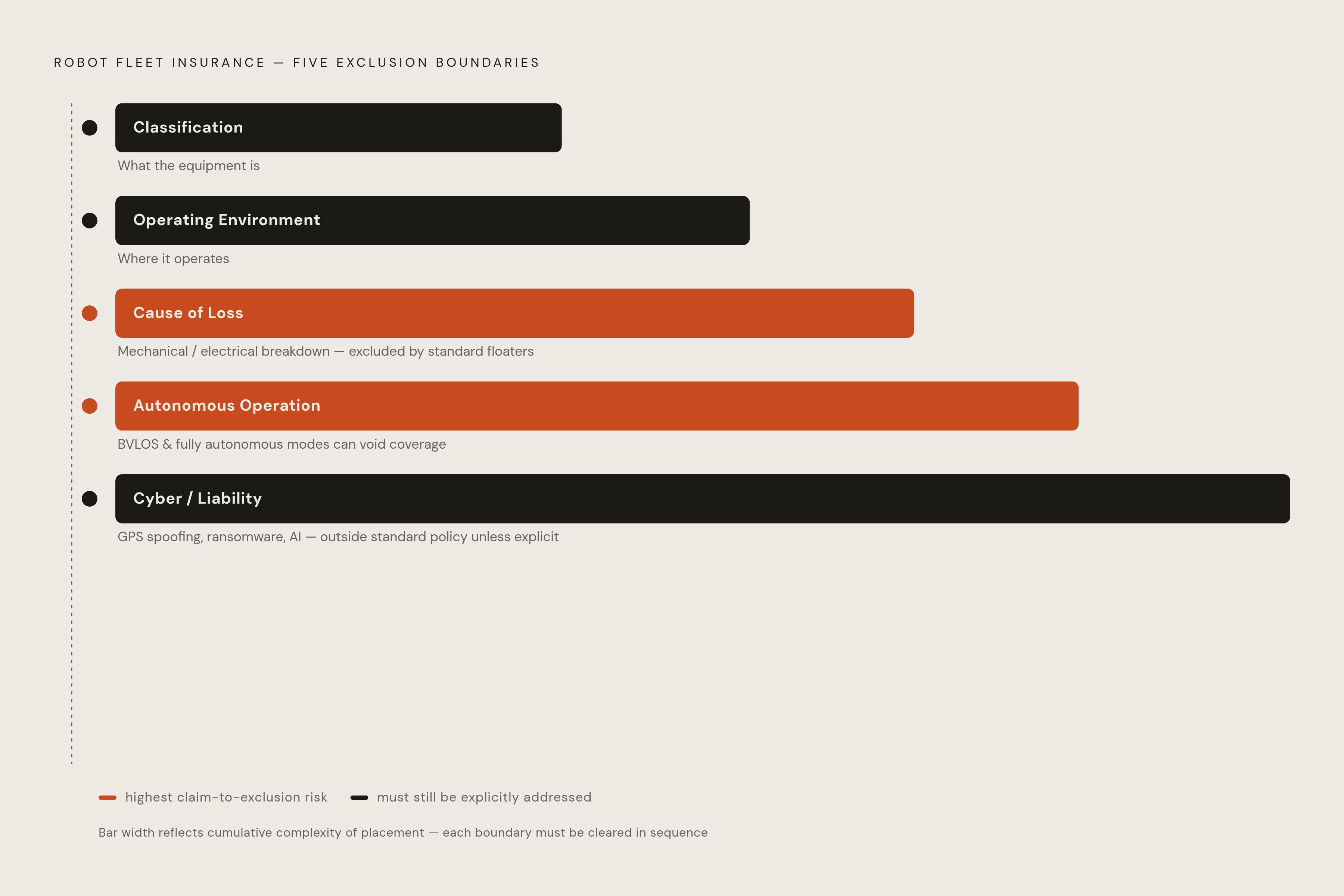
Ground robots face the same trouble with how insurers classify them, even though they are not aircraft. A specialized machine may be listed on an inland marine schedule even when electronic equipment sublimits are too low for its value. Its autonomous operation may also create liability that the general liability carrier questions under the base form. This repeats the ROV pattern rather than resolving it.
Mechanical or electrical breakdown is a particularly important boundary. Standard floaters exclude it, yet it is a central failure mode for robotic equipment. Drone operators learned to distinguish the aircraft from its support equipment and to examine flight restrictions. Robot buyers must make comparable distinctions between covered property damage and excluded internal failure, while also examining restrictions on autonomous operation.
Many floaters contain coinsurance clauses that reduce partial-loss payments when equipment is insured below the required share of its value. The software in robot fleets can lose value while the cost to replace hardware keeps shifting, so an old schedule may be a poor guide to what the fleet now needs for replacement. New units deepen that mismatch when the schedule does not keep pace. A schedule set two years ago can therefore be inadequate even when its original values were reasonable.
Liability also crosses more policy boundaries than the equipment floater addresses. Autonomous robotics can implicate cyber, professional and technology errors and omissions, property, general liability, products liability, and employers’ liability. Generative AI exclusions add another issue when their wording applies to the fleet’s systems, but that wording gives no reason to assume that all autonomous operation is treated alike. A GPS spoofing attack or ransomware incident disabling an autonomous mobile robot fleet may fall outside a standard robotics policy unless cyber liability is explicitly included. As with drones, an equipment policy is only one part of the placement.
How contract requirements arrive before the right coverage forms exist
Enterprise and government customers make coverage a condition of buying the work. Their contracts often call for general liability limits, an additional insured endorsement that names the client, and a certificate of insurance before work begins. Some also require hull or property coverage for operations over sensitive assets. The timing leaves little room for ambiguity. The operator must present the required insurance before the project starts, even when standard forms do not neatly address the equipment.
Government and defense contracts can extend those requirements further. They may call for umbrella or excess liability, waiver of subrogation, primary-and-non-contributory wording, professional liability or technology errors and omissions, and cyber liability. Subcontractor flow-down obligations pass requirements through the supply chain. As a result, an operator or supplier can face insurance conditions shaped by a larger project. That makes an accurate description of its work essential to the placement.
The contractual requirement and the policy’s response are separate questions. A contract can require general liability while leaving open whether that policy covers liability from the system’s autonomous decisions. Regulatory uncertainty around beyond-visual-line-of-sight operations adds another unresolved boundary for drone programs, but it does not replace the need to examine policy restrictions. For robot fleets, the immediate procurement obstacle is the same. Handing over the requested insurance documents leaves open whether the forms cover the work the customer is buying.
How to insure a mobile robot fleet across multiple locations with the right equipment floater placement
The practical response begins with an inventory of assets and operations. The submission should record make, model, and value, together with where each machine operates and what happens when it fails. For robots traveling between job sites, that description must include transit as well as work at each location. LIG Marine starts specialized equipment placement with where the equipment works and what it is worth.
Each item should have a physical damage form that covers it, whether hull or inland marine, and liability should have general liability or standalone coverage that covers the risks involved. The broker should confirm that allocation in writing. The drone experience shows why attached components, detached spares, support equipment, and equipment in transit cannot simply be assumed to follow the main machine. Each needs a defined place in the placement.
The exclusions then need to be read against real failure modes. Mechanical breakdown, cyber interference, and software-directed physical decisions test different parts of the coverage. For robot fleets, mechanical breakdown and restrictions on autonomous operation deserve particular attention because they can turn an expected equipment claim into an excluded loss. Scheduled values also need comparison with current replacement cost. That review addresses coinsurance exposure as well as changes in the fleet’s size and composition.
Third-party liability requires its own review rather than an assumption that general liability completes the package. Systems operating near infrastructure or on third-party property can create exposures the base form was not written to handle. The submission should also distinguish designing, manufacturing, integrating, operating, and supplying a single non-critical component. Those roles have different liability profiles. Blurring them together can cause the submission to be underwritten as the riskiest role by default.
Before binding, the submission should go to a specialist. Standard carriers write the risks they understand and exclude others, so the quality of the equipment and operations description affects both coverage and pricing. A submission built for machines in the field gives the placement a basis for addressing multiple environments, current values, and autonomous operations explicitly. The objective is a documented fit between the fleet and the forms. It is not merely a completed schedule attached to a familiar policy.
Why specialist placement for autonomous hardware costs no more than a generic broker placing it wrong
Broker commissions are already included in the premium whether a specialist or a generalist places the policy. The resulting premium can still differ because coverage and underwriting differ. That distinction is important when comparing quotes. A lower-priced generic placement that excludes the fleet’s principal failure modes is not an equivalent purchase at a discount.
Mature drone programs developed annual equipment audits, explicit hull-versus-inland-marine mapping, and policy language responsive to beyond-visual-line-of-sight operations after costly gaps exposed the need. Robot fleet buyers have that roadmap available before repeating the claims experience. Coverage that matches the equipment requires buying the right form, structured around what the equipment actually does, through a submission that specialist carriers can evaluate and explicitly cover. That is the work a specialist broker delivers, and the work a generic placement leaves undone.